Showing posts with label Botanic Island Three. Show all posts

Tuesday, May 5, 2015

A fungi morning

Large saucer - shaped  white fungus
Location : Provinsi Rattan, Zone I

Top view of white fungus
 This morning was a fungi morning.  I checked in at the Botanic Island Three especially at the Provinsi Rattan area.  There I stumbled upon three unique varieties.  One  exotic kind was a red Parasol Fungus.  Then there was one black and white fungus, all of which were seen close to dead and rotting fallen tree trunks.  Fungus produce reproductive spores.  Like many green plants they are assisted by insects to help disperse the spores.   Some fungus produce unpleasant liquid that attract flies which collect spores on their feet to scatter elsewhere.  Other fungi explode, scattering their their dust-like spores within the vicinity.  Another variety of fungus impregnate insects which move on and then die, providing nutrition for the fungi which grow from their bodies.  Upon infecting another insect they continue to scatter their spores thus sustaining their survival.
Red Parasol  fungus
Location : Provinsi Ratan, Botanic Island Three

White-rimmed Black fungus
Location : Provinsi Rattan, Botanic Island Three

Sunday, April 26, 2015

The Greater Coucal dries its wings

But-But Cari Anak (Malay) - Greater Coucal (Centropus sinensis) spreading out its wings to dry.
Location : Botanic Island Three, Zone I
The Greater Coucal with its long tail,
bluish black head and chestnut wings
There was a brief heavy rain early this morning which was a boon considering the long drought which we experienced for the last few weeks.  After the rain stopped I took a walk to Botanic Island Three.  At the edge of the forest that is part of the Botanic Island, I saw a large bird perching on a small tree branch.  It was the Greater Coucal taking a rest on the branch while spreading out its wings to dry after the rain shower.  The Greater Coucal is often heard with its characteristic 'But-But' sounds, but seldom seen.  It prefers to move quietly among the trees and branches from where it scouts for small animals like lizards, frogs and insects.  It usually makes short flights interspersed with gliding.

The Greater Coucal  takes short flights interspersed with gliding.

Wednesday, June 25, 2014

In Plain Sight - Provinsi Rattan (Part 6)

Partial view of Botanic Island Two, looking north
Location : Provinsi Rattan, Zone E

Botanic Island Two, showing rattan
trailing at the center.
 Of all the Provinsi or Plain areas, the Provinsi Rattan is the most wild in nature.  This is because in the Provinsi are located two Botanic Islands viz Botanic Island Two and Three.  At the Botanic Islands are preserved many forest trees for posterity.   At the inset is a view of Botanic Island Two , looking south.  Both Botanic Islands have rattan growing naturally in them, besides original jungle trees, unique palms, lianas and forest climbers. Presently there is one wild Rambutan tree that is fruiting profusely.  Seen also is a wild forest climber belonging to the Bauhinia species that is flowering in orange glory.  Below are more pictures of the attractions at Provinsi Rattan .....

Provinsi Rattan - home for rattan collection -  7 rattan species are available on site

Botanic Island Two - showing lianas and climbing rattan, at center

Stream at Provisi Rattan
Location : Botanic Island Three

The big tree at center is the wild Rambutan tree
Location : Provinsi Rattan, between Botanic Island Two and Botanic Island Three

Wild rambutan fruits

Colourful Bauhinia spp. climber growing wild over the forest canopy
Location : Botanic Island Two, Zone E

Sunday, July 28, 2013

Botanic Island and walk

Botanic Walk One, between Island One at left and island Two at right.

Fresh fruit bunch of the oil palm cut open
 There are three vegetation islands that are preserved for posterity in developing the park.  The park is built out of an integrated eco-farm based on oil palm cultivation.  Over the years I saw the potential of developing it into a park and ultimately an eco-resort.  This year I have decided to upgrade it into a park with oil palm farming as the main activity to raise revenue for maintenance and development purposes. The oil palm trees have been in commercial production since last year. The Botanic Islands in the park provide much diversity to the environment, besides becoming a haven for wildlife and micro-climatic dinamics.
Fresh fruit bunches of the oil palm eaten by squirrels..
Oil palm (Elaeis guineensis)

Squirrel at Botanic Island One

Botanic Walk Two , entering through the
island of lianas and climbers
 At Botanic Island Two, the attractions are the 'Tarzan' ropes!  Here there is a large collection of jungle climbers or lianas.  The jungle floor is thickly covered with fallen and decomposed leaves, branches, tree trunks etc that is characteristic of the jungle look. The branches are frequented by mammals, birds, bees and butterflies of many kinds.

Butterfly at Botanic Island Two.

Red-headed (Ashy) Tailorbird (Orthotomus ruficeps) hunting for red ants..
location : Botanic Island Two

Botanic Island Two, looking south

Lianas or climbers  reach to the top of some of the tall tropical hardwood trees at Botanic Island Two

Botanic Walk Three...entering the rattan territory
 The Botanic Island Three is home for the rattans.  Here can be seen 7 different species of rattan palms or rather 'climbing' palms. 
The rattans produce fruits that are eaten by many wild animals like the palm civet cat or what the locals here called "Musang".  The prevalence of many wildlife will be rewarding for those interested in birdwatching and other wildlife subjects.
Fruits of the rattan
location : Botanic Island Three

Fungi at Botanic Island Three

"Musang" or the palm civet cat

Sunday, July 7, 2013

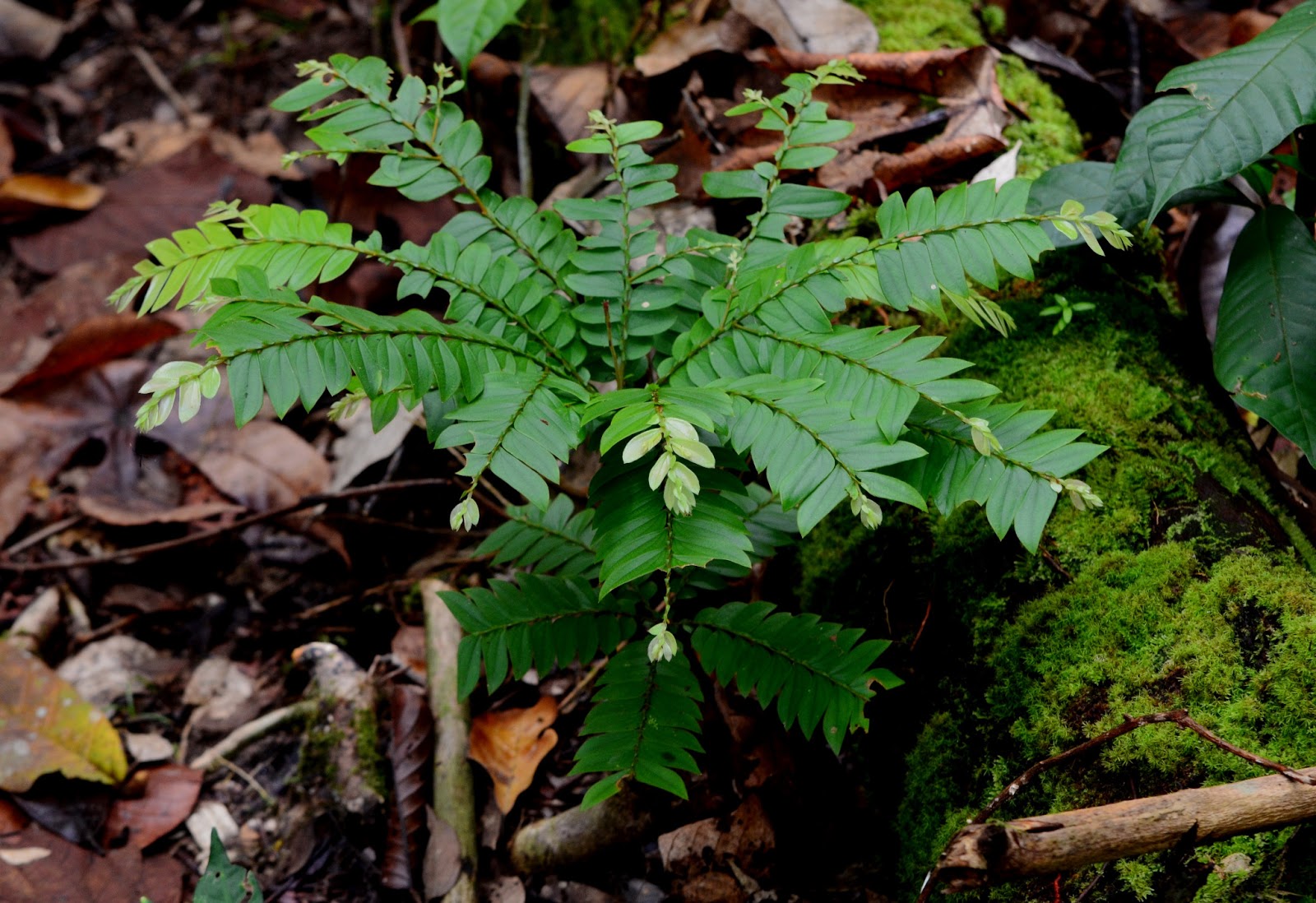
Plant for bodily welfare and vigour - Anisophyllea disticha

Anisophyllea disticha - 'Kayu penahan badan' (Penan), flower buds are deep red and fruits are dark brown..

 Today is the first time that I come across the flower buds of the Anisophyllea disticha or what our Penans of Borneo call ' Kayu Penahan Badan' to mean plant for general body welfare and vigour.  I have preserved a dozen stands of these useful herbal plant in many locations of the park.  This is a small tree that grows to about 6 meters high.  It has charateristics that is interesting as a landscaping plant viz its willow-like branches but looking tidy, small and hardy tree which can grow in shade and open sun.

Anisophyllea disticha, location : Provinsi Rattan

Anisophyllea disticha, location :Botanic Island Two
Among the Penans and Berawans of Sarawak, the roots of this tree are dried and boiled and kept in containers.  They bath their children regularly with the boiled water as herbal treatment for general body welfare and youthful vigour.

Tuesday, June 25, 2013

Nature discovery at the park

Orange cup fungus with white hairs seen at Provinsi Rattan area.

 Today I decided to check out the Provinsi Rattan area to enjoy some shade in deep rattan territory of the park.  It was a worthwhile excursion.  The place was rather damp, well-shaded and close-by the stream.  Here can be found many rattan species. wild exotic palms, lianas or climbers, and many natural organisms that feed on the thick forest floor of humus, dead plant tissues etc..One particular fungi attracted by attention.  The fungus were living of a small dead branch and they hard a striking orange colour with white hairs.  Many things can be discovered here...here's a tiny sampling of fungi types, rattan species showing fruits as well, fern and and an exotic palm.
Fungi at Provinsi Rattan area.

Fungi at Provinsi Rattan area.

Fungi at Provinsi Rattan area.

Fungi at Provinsi Rattan area.

Fern at Provinsi Rattan area.

Rattan fruit at Provinsi Rattan area

Rattan fruit at Provinsi Rattan area.

An exotic jungle palm - Pholidacarpus sumatrana , located at Botanic Island Three, Provinsi Rattan area...