Showing posts with label Kruak wetlands. Show all posts

Saturday, March 10, 2018

A monitor lizard at Kruak wetlands

Monitor lizard basking at the edge of Kruak Wetlands
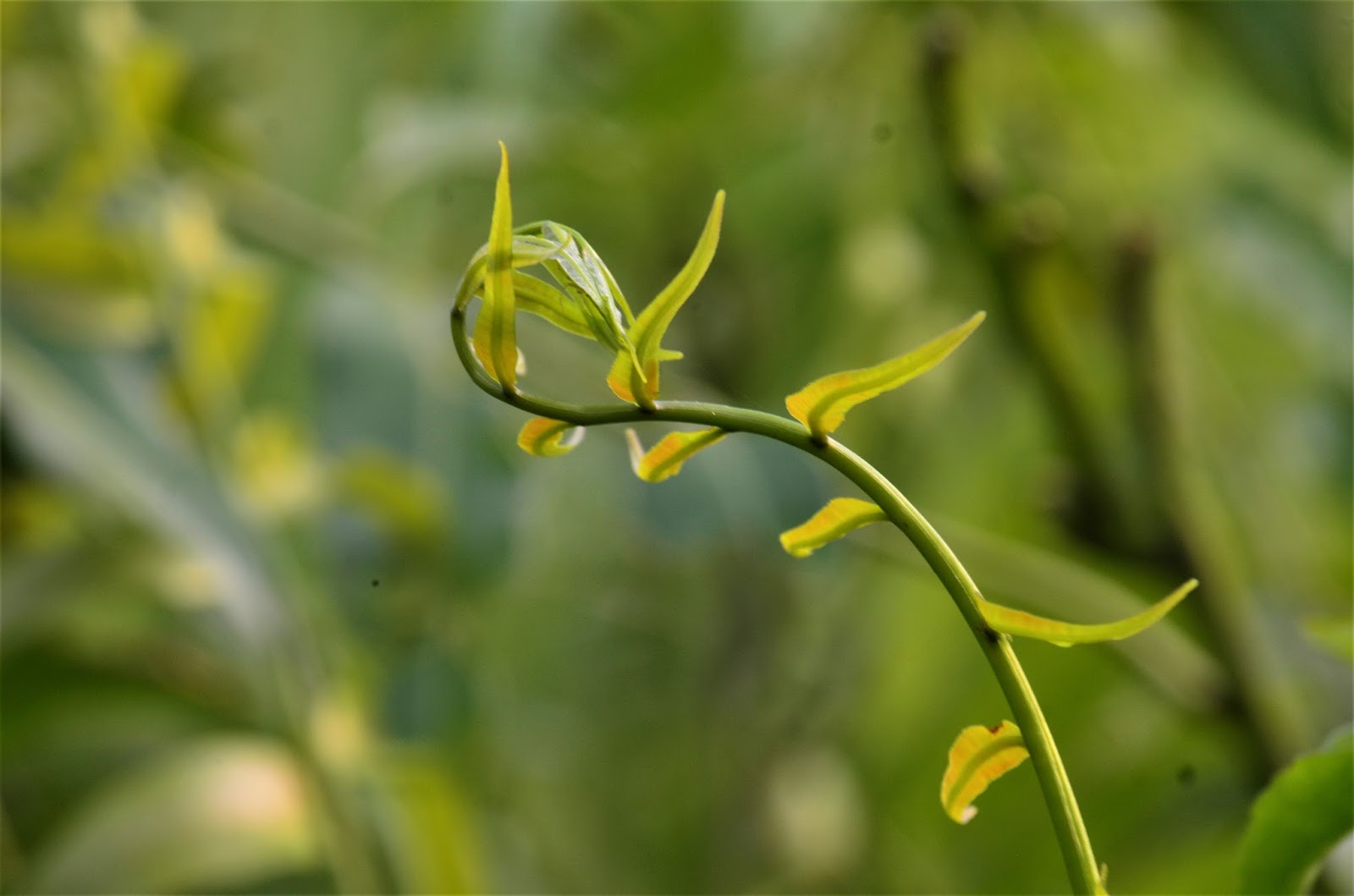
Edible young 'Miding' fern.
The Kruak wetlands has  brought a big surprise today with the sighting of a monitor lizard.  A tall dead tree nearby was a perfect place for it to bask in the sun.  The area seems to be a favourite place for the lizard primarily for its damp and wet ground, thick vegetation to hide and probably for the availability of food.  It is also my favourite place for collecting the "Miding' ferns for vegetable cooked with the popular local paste called 'Belacan' of course! On the sidelines I met a lone Shield Bug clinging to the broad leaf of the 'Simpoh Air' (Dillenia suffructicosa).  The Kruak wetlands is thickly populated with the Simpoh Air plant.
The tall dead tree is seen in the middle of the picture.  In front is seen a section of Kruak Wetlands that is thickly populated with the Simpoh Air (Dillenia suffructicosa) shrub.
Shield bug, many are seen clinging on to the broad leaf of the Simpoh Air.

Sunday, October 25, 2015

The wild Phaius orchid is flowering


Keruak wetlands at left and back of
picture
 Working at Zone B this morning, I noticed the wild orchid of the Phaius variety is starting to give out flowers.  The last time it produced pods, I did broadcast the spores and to my pleasant surprise have germinated.  There are at least a dozen of new seedlings seen around the main stand now.  I intend to move some of these new seedlings to other locations to study its adaptability and growing success.  This variety of the Phaius orchid seem to prefer  filtered light  and  wet ground with rotting organic biomass.
Wild orchid of the Phaius variety
Nearby the Keruak wetlands area, Zone B.


White spores revealed after the mature pods are opened.
Zone B.

Sunday, July 5, 2015

Two birds and a chick

Magpie- Robin or Murai Kampung (Malay)
Location : Cempedak Hill, Zone G

 On a Sunday morning, I thought how pleasant it would be to have a stroll around the park.  I was trying to look for a surprise.  Any surprise.  The surprise came in the form two birds and a chick.  Firstly, the Magpie Robin was singing her heart out to the denizens of the park.  Pitching her voice to a melodious tune, her song ran for a couple of minutes but stopped when she spotted me.  Later, at the same tree a lone Blue-throated Bee-eater took  to the perch unnoticed by me but soon as I took a glimpse of it, the colourful bird flew away.  It has been a while since the bee eater has been spotted perching on the Cempedak tree.  Finally, as I was about to finish my morning walk, my eyes were focussed on a black object that moved about the short grasses near the Kruak Wetlands.  And sure enough it was a young White-breasted Waterhen, but because it was still very very young the white breast didn't show.  She was all black.
Blue-throated Bee-eater

Young chick of the White-breasted Waterhen

Young chick running for cover
Location : Kruak Wetlands
 

Friday, May 22, 2015

A pair of Little Green Pigeon building nest

A pair of Little Green Pigeon seen perching on a nearby tree close to its nest, which is seen below.
The nest is seen from below. the tree.  At the centre of the mass of leaves is hidden the nest of the Little Green Pigeon.
Location : Kruak wetlands.
Zone B
A pair of Little Green Pigeon perching on a branch.
I was not able to see any thing inside the nest of the Little Green Pigeon. The nest was way above my head.  I just discovered that a pair of the Little Green Pigeon has started to build a nest amidst the branches and leaves of a small tree near the Kruak wetlands at Zone B.  It was when walking below the tree that I heard the loud flutter of wings.  Surprised, I look upwards  and saw a nest formed by a collection of twigs.  It was obviously the pigeon's nest.  Thy have rushed out of their nest upon discovering my presence.  The pictures above show them perching on a tree nearby.

Thursday, January 22, 2015

New terrestrial orchid found


 Found a new terrestrial orchid with upright flower spikes at Zone B yesterday.  The area is at the edge  of the Kruak wetlands.  The damp earth covered with rotting branches, fronds and leaves have provided the ideal conditions for this new discovery.  At this point of writing I'm still unsure what species of wild orchids it belong to. Could it belong to the Nephelaphyllum tribe of which the Tania is a likely candidate.  Or it could be placed under the Phaius tribe of which two genus are relevant i.e. Phaius and Calanthe.  I'll study in further detail this new find and will revert in future posting its likely nomenclature.  What excites me is its colourful sepals that are a light brownish purple.  The two petals are whitish and the lip is a nice subtle brownish purple with attractive orange brown centre leading to its reproductive parts.  I have reserved a name for it....

Wednesday, January 21, 2015

Advancing into Kruak wetlands

Red Dragonflies are a common sight at the Kruak Wetlands

Thickets over the Kruak wetlands
 'Kruak' in Malay refers to the White-breasted Waterhen.  The Kruak wetlands is situated between Zone B and Zone C and is a low-lying basin between two hills.  This wetland area is covered with thickets of the Shrubby Dillenia, heliconia plants,bamboos, palms, ferns, creepers, grasses and small trees, while the surrounding hills are covered with lowland dipterocarp forest species.  Often the Sambar deers will leave trails of disturbed grasses after they have combed the wetlands areas during their nightly visits.  Today I worked hard on draining some of the water from the wetlands area by manually digging more drain outlets into the areas frequented by the Sambar deers.  It is a satisfying feeling to see the  many deer trails abound in the area.  The Kruak wetlands is also home to many birds, small mammals and insects.  It is the best area to photograph dragonflies.  The birds that regularly visit the wetlands area are like the Little Spiderhunter, Browh-throated Sunbirds, Prinias, Bubuls, Crimson Sunbird and the shy and fast running Kruak or White-breasted Waterhen. 
Thickets of Heliconia plants are attractive to many birds species

Typical lowland dipterocarp forest ecology surrounding  the low-lying  wetlands.
The palm at the center of the picture is the 'Nibong' (Oncosperma tigillarium)