Showing posts with label Zone F. Show all posts

Thursday, April 19, 2018

Flash floods and some views of the park in April

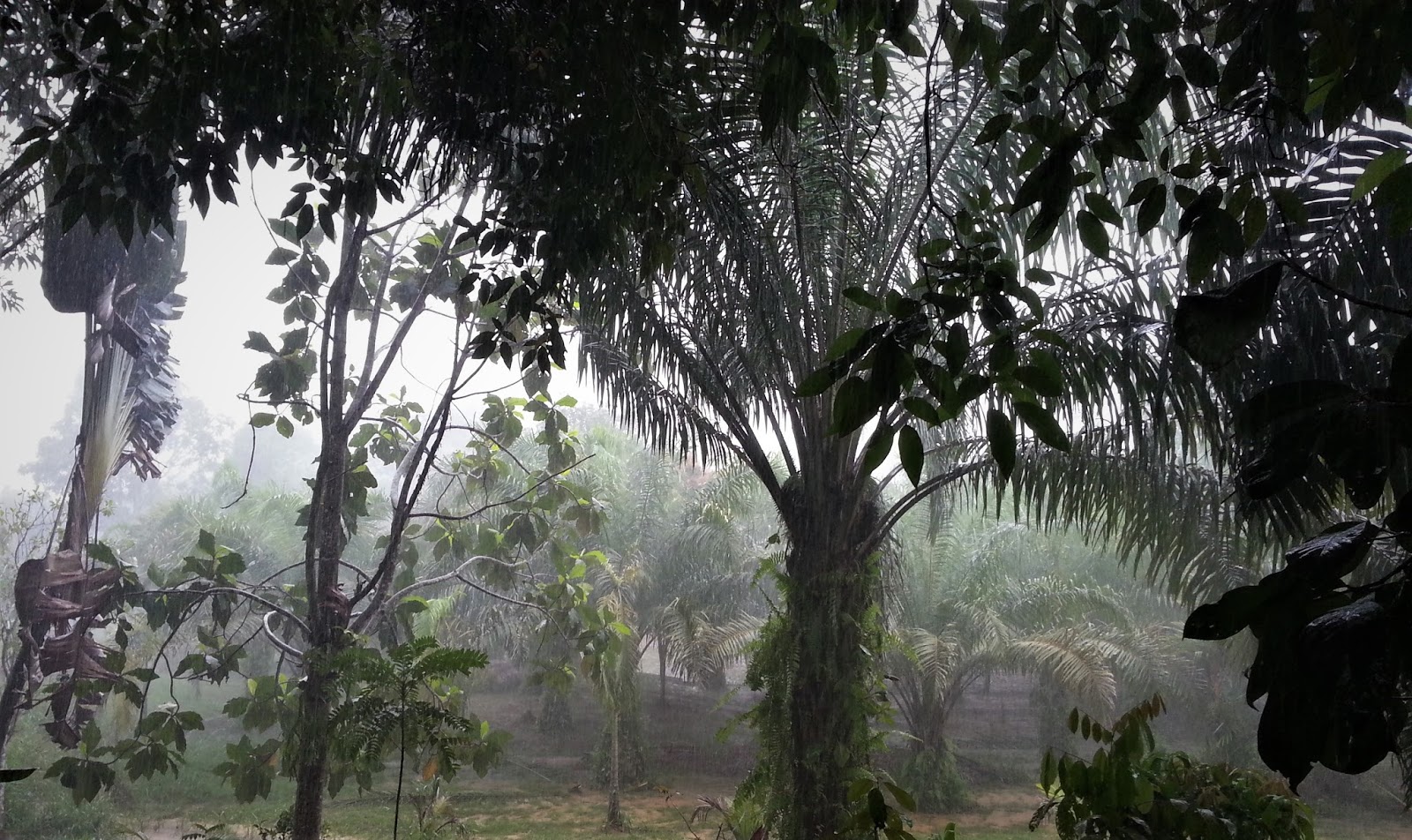
Zone F  in heavy rain.

 It has been raining heavily for the last three days (mainly nights).  The parkland is situated on a very hilly area and is the headwaters of a stream, which for convenience I call the Kambatik stream.  The heavy downpour would normally create flash floods.  However, due to its hilly landscape the excess downpour would race downstream.  This event is exciting to watch and offers some fine photographic moments.
After the floods, I walked up the Cempedak Hill and found a lone Plaintive Cuckoo.  This time it is the female of the species, a lifer for me.
Here are some views of the park taken in April’18.
Flash floods at Zone F

Zone B

View towards Zone A, looking east, from Cempedak Hill (Zone G)

Wednesday, September 28, 2016

After the cutting

View of Zone E , looking south

Zone F, looking west
 The grass cutting operation is regularly done to help change the perception that an oil palm plantation need not look like an uninhabited place, unkempt, dangerous to walk around and of no beauty.  The proceeds from sales of the ffb (fresh fruit bunches) have been instrumental in providing the means to undertake grass cutting works at the park.  This is because the grasses here are never applied with weedicide since day one.  Based on the Kambatik landscape design philosophy and aesthetics, it is indeed a pleasure to work and walk around the park.  After about ten years of development, the natural environment is flourishing well as evidenced by the return of wildlife to the park, chiefly the birds, butterflies and bees.   Here are some photos showing areas of the park taken just after the grass cutting operation at Zone C, E and F.
View of Zone C, near Butterfly Garden, looking east.

View of Zone E, looking north

View of Zone F, looking south

View of Zone E, looking north

View of Zone E, looking west.

View of Zone E, looking south

Tuesday, December 29, 2015

After the flash floods

Flash floods on 25 Dec'15
The stream back to normal size on 30 Dec'15
Location : Provinsi Carpentaria, Zone F
Note: The tall tree at the foreground is a wild 'Rambutan' tree species.  This is one of the oldest cultivated tree at the park and despite its 70 years old age has been fruiting luxuriously this year.

Sunday, December 27, 2015

The 'Queen of Sarawak' palms bearing fruits

The top branch is showing inflorescence and the lower branch shows the ripe fruits.
The  inflorescence (flowering structure) is highly branched to 3 orders and spreading.
Picture shows the orange variety.
Location:  Provinsi Lakka,  Zone F

 I have great love for this 'Queen of Sarawak' palms – the Sealing Wax Palm or 'Pinang Raja' or 'lakka' as it is variously called. It grows naturally in Bintulu's peat swamp forest areas but what I have done here is to transplant it in a lowland dipterocarp forest environment. No problem. It is a palm that can thrive well even when removed from its original habitat. There are two species I plant here viz the orange form and the red form. The brilliant orange or red colours that one sees is actually the sheath or leaf bases. Seen from a distance these leaf sheaths form colourful crown shafts and thus make the palm a preferred choice for the 'exotic tropical look'. These leaf sheaths will fall off the erect stem when they are old and in the process leaving leaf scars. The Sealing Wax Palm has a clumping habit, which I think is a blessing because offsets can be cut off from the clump and become new planting materials. Another way to propagate this palm is by germinating the seeds. From my experience the growth rate and germination rate is poor when grown from seeds. Thus better get fresh materials from the main clump's offsets.

After flowering, fruits are formed in shallow pits on the rachilla or branch bearing the flowers ( and later the fruits). Guess I'll try my luck again to germinate those seeds below.

Ripe fruits of the 'Pinang Lakka'  held in shallow pits.
Sealing Wax Palm - Cyrtostachys renda
Syn: Crytostachys lakka

Monday, November 2, 2015

A lifer of a blue flycatcher


Eumyias indigo
Zone F
 What makes my day today is the capture of the blue flycatcher.  It's a lifer for me and for the Kambatik park.  Today is the first time I stumbled upon a blue flycatcher.  I first met it at Zone F and then followed its movement to Zone D about 100 meters away before it disappeared into the surrounding forest.  Is it a  female of the species?  Is it the Indigo Flycatcher ( Eumyias indigo) that is a native to the island of Borneo and therefore Bintulu?  The literature mentions that the Indigo Flycatcher is a resident of the highlands and less frequently seen below 3000 ft above sea level, that is in the lowland dipterocarp hill forest where the park is situated.  At first sight I saw it jumping and hopping on the leaves-covered ground for insects and was not particularly scared of my presence.  Whats striking about the upperside of the bird was the deep blue colour of its crown right down to its back.  In most descriptions the throat and breast is blue but in this specimen it is white.  Does this mean that it is a female of the species?  I have yet to determine this and it is my fervent hope that it will drop by again at the park soon with a mate. to confirm my observation.  Hopefully that day is near.
Indigo Flycatcher ( Eumyias indigo)
Zone D

Wednesday, September 30, 2015

Give your passion your everything


Stream near Zone F
It is a pleasant walk,
Past mature trees,
Of forest old and and new planting,
With every step I stride,
The strength in me says,
You have got it right,
Give your passion  your everything.                                                      


Note: All pictures above show some very old native trees at Zone F, mixed with new planting of oil palm and other ornamental/fruit trees.

Monday, September 28, 2015

The Cassia javanica is doing fine

Cassia javanica growing well at Zone F

Pink flowers of the
Cassia javanica
 I have planted the Cassia javanica, grown from seeds, at Zone F a few years ago.    Today, I noticed the tree is growing well.  I am looking forward to this tree bearing flowers and fruits so that I can propagate it and more of these beautiful trees adorn the park.  The pictures of the flowers here have been taken from another location, along Sarawak trunk road where many times I dropped by to collect some of its pods.  The germination rate is very low and so far this is the only tree that managed to survive from the many seedlings I planted.

A Cassia javanica tree in heavy flowering along Sarawak trunk road.
Taken in 2011.

Wednesday, August 26, 2015

Wild and beautiful Rambutan

The Rambutan fruit
This tree is about 70 years old but is standing tall, next to the stream at Zone F.  The Rambutan tree belongs to an age-old variety.  It isn't a hybrid. Its high stature is shared with the Balem tree nearby and both claiming to be one of the earliest species planted by predecessors  on this little green spot of our tiny blue planet.   It is precisely on this matter that  I have deep respect for both trees for their "will" to survive.  When I see it producing an abundance of fruits this year, the best in its fruiting history so far, I feel blessed to have its presence in the park. Talk about the taste - well, this is an age-old species or wild species as you might call it, and it tastes sweet and sour.  More sweet when it is very ripe than sour.  So there you have it, a wild species that still thrive  the vagaries of nature, wild and strong, wild and healthy, wild and productive, wild and beautiful.

Note the size and height of the Rambutan tree trunk.
Location : Zone F

Wednesday, April 15, 2015

The meandering stream

View of middle section of the stream as it passes by the verandah or 'Abag' in local Bintulu Melanau terminology.
The broad leaves in the foreground belongs to the 'Jambu Bol' tree (Syzygium malaccense)
Since it is very dry season at the park right now I guess I'll take a moment to share on the status of the stream.  Yes, the water level is very low.  This situation enables me to carryout much clearing works on both sides of the stream.  The pictures in this posting show the middle section of the stream where it meanders and form somewhat like dragon back outline in the middle of the park.  On the sides of the stream the land is flat and its where many types of introduced tree species are planted.  These trees could be fruit trees, flowering trees or palms.  The planting idea is to allow for walks along the stream in shade as much as possible.

View of stream meandering
Foreground is the 'Pong-Pong' tree with its apple-like fruits which turn red when ripe.
This is an example of ornamental planting.
Location: Zone F
More ornamental and fruit tree planting along the stream...coconut palms, Carpentaria palms and flowering trees and tall fruit trees at right of picture (in the background)

Friday, March 6, 2015

Eurasian Tree-sparrows frolicking

Eurasian Tree-sparrow (Passer montanus) or in Malay  'Ciak Urasia' perching on the 'Ong Lumok' branch

Eurasian Tree-sparrow
 The phenomena of the tree-sparrows just happened some few months ago.  One day I noticed one bird came to the park.  A couple of weeks later I saw two dropped by.  Towards the end of 2014 there were a about a dozen of them.  By early this year their numbers seemed to grow more than 20 fold.  I have come to accept that fact that they are now a permanent feature of the park, and growing.  Today I saw a dozen or so of them frolicking in shallow waters at Zone F.  They were seen splashing the waters and seemed to be happy having their morning bath.
Eurasian Tree- sparrows frolicking in shallow waters
Zone F

Perching on the leaves of the oil palm
Zone F

Tuesday, October 28, 2014

Pick of the park - Candlestick Cassia

Candlestick Cassia - Cassia alata
Syn : Senna alata
Location : Provinsi Carpentaria, Zone F

 This plant does not need maintenance at all.  Preferring to survive on damp areas.  For that reason I grow them along the stream and flood prone areas of the park especially at Zone F, near Provinsi Carpentaria. The flowers are yellow and before they see the sun are enclosed in orange bracts.  This plant can be easily grown by seeds and the germination rate is almost 90%.  Best grown in a mixed border arrangement but make sure to provide shirting of lower shrubs or other cover plants  to avoid showing the leggy lower parts of its stem.  The leaves are used in traditional medicine as cure for ringworm and other skin diseases.
Candlestick Cassia or 'Serugan' in Iban  - Cassia alata
Family : Leguminosae - Bean family

Wednesday, September 24, 2014

Photoshoot session with the Green-crested Lizard


 Today I was given a rare opportunity by the Green-crested Lizard for a photoshoot session.  Enjoy the beauty of nature and its wildlife....