Showing posts with label Philosophy. Show all posts

Wednesday, May 4, 2016

Loving the emergents

Botanic Island One

Botanic Island One
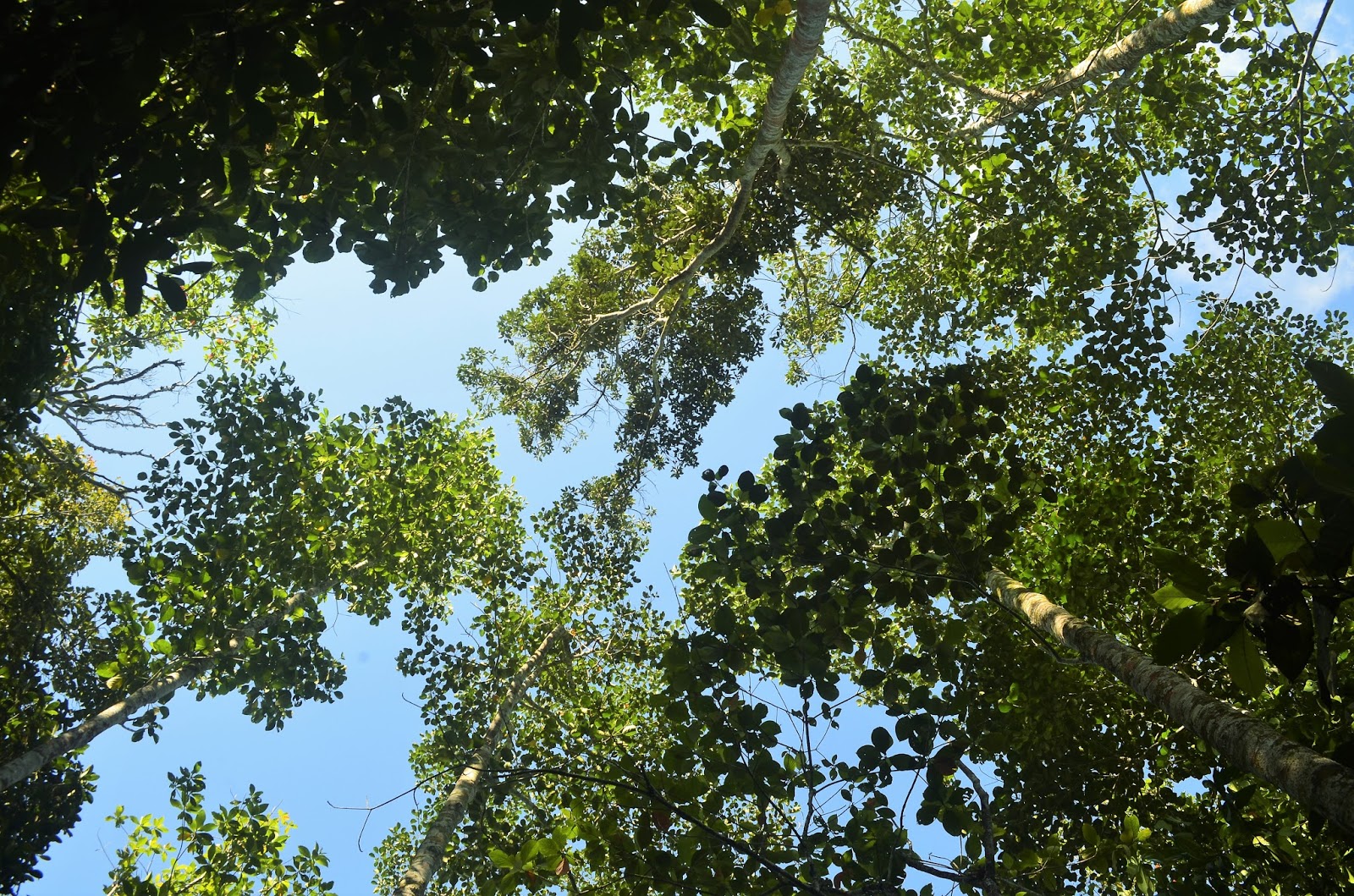
 I love the emergents.  For in the rainforest ecology of the park,  these super tall  trees rise above the landscape with a respectful 20 - 40 meters  high from the humid and leaves-littered forest floor below.  These are the forest wonders that delight me in my daily walks, their majesty proclaiming their age, rising above the competition and giving the iconic canopy and structure of the lowland dipterocarp forest.  These trees are retained as part of the agro-forestry practice of the nature park.  They are the answers that I worked hard on for many years now i.e. to re-live the green landscape of the village where I was born.  I am blessed daily to watch them grow,  close enough to walk below them, touch them and feel the ameliorating air below them. Trees are basic to any landscape, the taller the more original is the landscape.  This is so because we are living in the tropical rainforest zone on Borneo Island which contains one of the oldest and richest ecological diversity gems on this planet.  Life is really worth living with them as neighbours,
Zone D

Zone C

Sunday, April 26, 2015

Clear stream revival, sounds familiar?

Location : Provinsi Carpentaria
Does it sounds familiar?  Clear stream revival! This is the phenomena after every major flash floods that happen in the park.  Follow the stream and you will discover its beauty after it is washed off all the unnecessary debris and murky water that abounds by its sides under normal conditions.  After every torrential rains the stream gets spring cleaned.and refreshed with cleaner water. Because the standards of development at the park are high, the water quality is very good.  In fact, you can bath using the stream water.  The stream is a reflection of life.  The only constant in life is change.  There  are always changes in  contemporary life, the changes are increasing accelerated and becoming more complex.  As the stream flows downriver and into the open sea, it slows down.  It faces friction, conflicts as it lands itself in more level-playing field.  Competition hots up.  What are we to do with life?  Two things I learned today by watching the stream.  Firstly, it is to accept change as part of life and complexity a challenge as we advance in years.  Secondly, what is more important is to understand the direction of change.  By having a good grasp of where we are going we are every ready to face life's complexities and opportunities.  Precisely at this point of writing these words somehow pop out of the blues ...Opportunity awaits the prepared mind.

Thursday, January 15, 2015

Gardening the Butterfly Garden

Ixora coccinea at a corner of the Butterfly Garden

 In times of rainy days it is best to do gardening especially planting activities.  Today, in between moments of drizzle and rain, I make time to carry out some transplanting and also actual planting works at the Butterfly Garden.  The chances of survival are better on rainy days as the newly planted species receive immediate care in the form of water and cloudy sky to help reduce the initial planting shock.  I planted the Ruellia colorata plant at the Butterfly Garden this afternoon. Most of the time however was spent on digging more topsoil from the hill nearby  and placing it on the existing planting beds.  Before the evening fades my hard work was paid in full  by the amazing sight of the rainbows on the eastern horizon.  Another day is done.  A day feeling determined and hopeful that more butterflies will show up at the garden in the near future.  Well that sounds familiar..adventure in life, hands-on, looking into the future, always better, like a child ever more curious and learning....
Ruellia colorata
Family : Acanthaceae - Acanthus family

Rainbow on the eastern sky.  A day is done.

Wednesday, December 31, 2014

A new year, renewed hope

Musa hirta- variously called as Pisang Hutan (Malay); Pisang Lengki/Kera/Gentu (Iban); Pisang Giang (Bidayuh)
Location:  Botanic Island One

 The first day of the new year and has been drizzling since dawn till about 10 am.  I took the first opportunity to have a walkabout with an umbrella and a camera.  Surprise is too mild a word.  Feeling exuberated, full of jubilations I came across the 'Monkey Banana' which is what the Ibans call the wild banana Musa hirta.  It has survived many fortunes of the jungle.  There on the jungle floor it managed to keep itself alive, next to a dead trunk.  It is a good sign for the new year, giving me much renewed hope.  The wild orchids especially the Bamboo orchid (Arundina graminifolia) seemed to enjoy the environment and over the past year has multiplied in numbers, without a care of the world.  The many little birds that are born in the park and calling it home came out early to enjoy the nectar of the heliconia plants.  Chief among them is the Little Spiderhunter.  Her bill was made to fit nicely into the orange bracts of the heliconia inflorescence thus empowering it to enjoy nature's bounty, even in flight.  Climbing up the steep Cempedak Hill, I notice the bee-like social wasps have constructed a pretty looking nest hanging from a branch of the Cempedak tree ( Artocarpus integer).  Coming close to the nest I could sense they were slightly agitated by the clicking of my camera and my umbrella.  A few came out of the entrance of the nest and with abdomens erect were ready to give me a sting if I moved in closer.  I gave up.  I don't want to end my first day of 2015 in bed.  Be safe, be happy, be kind and compassionate for 2015.
Bamboo orchid - Arundina graminifolia

Enjoying nature's bounty even in flight - Little Spiderhunter

Like the bees we are winged insects (or wasps) , forever bringing home knowledge and learning.  Home is where the heart is.
"We, men of knowledge are unknown to ourselves." ...who says so?

View of lowland dipterocarp forest preserved at the park
Location : Zone B

Oil palm trees in mixed planting to add to existing bio-diversity and produce income to help fund conservation activities at the park.

A truly wild-type of Rambutan tree, as part of the gene pool at the park.

Thursday, December 11, 2014

Ecomarketing the Kambatik Park 2015


 The year is coming to a close and I'm thinking of what to do for the Kambatik Park next year.  For one thing it took me a good 3 years already to develop the eco-farm into a nature park.  I have created awareness of the park since last year with continuous blog postings (2013=150 ; 2014= 292 as to date).  So I think the next level is to do some serious ecomarketing of the park.  Marketing is an interesting topic because it enables me to understand what business I'm in (value proposition) by looking inside out (organisational effectiveness) and outside in (customers needs and benefits they buy).  My business value proposition in simple words,  I'm in the business of oil palm farming the ecoway.  But business is again a much misunderstood concept.  The western industrial economics tradition have pushed profits as the main motive.  Though environmental economics come into play, its position as an appendage to industrial economics has its limitations and resulted in ways that are not nature-centric and anthropogenic.  To me business is a social being and also a natural being entity.  This is the perspective or model that I would try to market next year.  Why I have come to this position is because of the variety of ecological experience I had at Kambatik Park.  But more than that , I would like to infuse the aesthetics of living a beautiful life in the Kambatik model of oil palm farming.  This would then answer the questions that always bugs me - how does ecomarketing meet the social needs of my customers (value and benefits they buy) , my needs of an unique individual (self-actualisation values) and the the natural ecosystems needs, per se and the oil palm business it derives sustenance from.  It looks like it's gonna be a real adventure in life next year.  Looking forward to 2015!

Sunday, December 7, 2014

Home is where the heart is

A December sky in painted canvas of dark and massive blue clouds.\

 Back in Bintulu.  Looking west I saw a December sky in painted canvas of heavy and massive  dark blue clouds.  They seem to promise more rain tonight.  Walking back from the hills, I walked past many columns of jungle green, islands of botanical interests and a feeling of freedom.  Truly living in the city chokes my being, and makes me yearn the fresh country air, the jungle footpath and an occasional orange dragonfly to greet me along the silent walk.  Here I find my spirit free to roam the landscape.  In my composed mind I say; home is where the heart is.
A walk in the Kambatik park

The two Tiongs waiting for an appointment with me...business as usual


Monday, October 13, 2014

Sustaining the forest beyond

Cultivation of oil palm (as means) to sustain the rainforest ecology built around the existing original lowland dipterocarp forest eco-systems.
View of Zone G from Zone C, looking south

Botanic Island Two in the background
 There are two M's that can help me make the forest ecology of Kambatik Park a success.  First M is a strong MIND, a will if you care.   Second M  is the MEANS, without which you cannot develop and later maintain a nature park.  The park was fortunate because from its inception the existing preserve of original vegetation was not totally destroyed.  They were isolated and preserved as botanic islands of which there are currently four.  The oil palm cultivation were integrated around the islands , streams, swamps, slopes, roads and hills in order  not to destroy the original land form exceedingly.  Income from the oil palm harvests is the principal means to sustain the operation and maintenance of the forest ecology.  It is important to bear in mind that the real beneficiaries of the park are the wildlife and plants ecological diversity  and we humans need to re-learn to co-exist with them to really benefit from natural world, be it in agricultural productivity, tourism-related business or recreational activities.  Today when I take walks in the park, I feel so much peace with myself for having positively contribute to the  understanding and standing for nature.  The Kambatik Park is a first step in my journey to really take care of nature by seeing beyond the trees.
Plain areas as fallback positions in time of flash floods due to torrential rains
Natural and man-made forest eco-system integration

Eastern Crimson Sunbird brave itself to come out of the jungle to search for food on the cultivated garden areas of the park

Mormon butterfly in the Botanic Island Two

A walk in the park is the simplest means to commune with nature

Tuesday, October 7, 2014

A focussed 30 minutes with nature

On the forest floor this climber is a duo-colour named Bauhinia semibifida.

 Early in the day before I start any work in the park, I would take a brief 30 minutes walk to catch up with nature and what it has got to offer.  The best time would be between 6.30 -7.00 am.  Everyday is a surprise.  Every day nature is full of offerings.  Everyday is a lesson learnt in nature discovery.  Walking through the Botanic Island One I felt a sudden change in temperature because of the tall trees that over-top the place have filtered the early morning light.  The air on the forest floor was very cool and fresh and breathing became inspirational due to the smell of fresh leaves, fragrant flowers and tons of pure oxygen.  Your spirits get rejuvenated for very brief seconds but then that's probably what you need to kick start the day.  Nearby Botanic Island Two, I noticed some commotion and heard bubbling sounds above.  The Yellow-vented Bulbuls were having a field day catching bees at the canopy of jungle trees.  We can't easily see their prey with naked eyes from ground zero  but often I see bee-eaters and bulbuls getting excited in the air above when chasing and catching the bees that normally come drifting in swarms  brought by a slight breeze or strong wind. Looking up again at the tree canopy, I was pleased to see the mild red flushes of a jungle tree.  It made me wonder - why not make it into a landscaping tree candidate?  Just like the Bauhinia semibifida climber that are well-preserved at the park.  They start as jungle species but can adopt themselves to urban environment to enrich and colour our homes, towns and parks.  There's so much to live and love nature every day in our lives.  Try walking in a park.
Bauhinia semibifida growing healthy at Botanic Island One

Bulbuls having rest perching and getting ready for the next sortie ..

Bubul with a bee at its beak

Mild red flushes of a jungle tree

Green Green Grass of Home...

Heralding a cloudy day and probably rain ...

Thursday, June 26, 2014

Less is more


 I am a fortunate guy.  The park is my lab for understanding nature in my private time and place.  Living in a lowland dipterocarp forest environment has provided me with the opportunity to internalize the global concerns of global warming, rainforest destruction, disappearing natural wildlife and untoward corporate greed.  For example the capitalist model of massive consumption has brought much destruction of nature.  In oil palm monoculture, whole original forests in Sarawak are stripped to ground zero only to be replanted with a single oil palm crop.  This unimaginative capitalist urge in corporations is largely driven by quantitative results in the name of  maximum profits.   But in the Kambatik philosophy less is more.  Here oil palm is well-integrated into the existing agro-forestry practices that resulted in increased bio-diversity, more value to the land as in potential economic spinoff in eco-tourism.  In particular this concept can uplift Sarawak into the only state in the world to possess a string of  park lands and nature reserves that can sustain itself through oil palm integration.  Imagine the total length of 800 km of Sarawak's country side situated along the trunk road turned into a continuous  band of wildlife, rainforest biodiversity, eco-tourism centers and the longest learning lab in the world.  This is my hope.
Oil-palm integration into native agro-forestry practices...

A pair of Brown -throated Sunbird finds home at the Kambatik Park...

Saturday, June 14, 2014

Walk on leaves

Partial view of Heliconia Valley, Zone D

 There is something earthly, energizing, romantic  and probably sexy walking on brown leaves.  The cracking noise of leaves squashed underneath the foot, step by step, reverberates through the peaceful jungle air.  They speak of country peace, balming one from earthly confusion, world's apart from the tense air of concrete jungle where urban souls sought to fight in the name of competition and success.  To live by nature comforts  my soul.  It prospers the plants and wildlife ( and hopefully prosper others). 
Footpath at Botanic Island One