Showing posts with label Agro-forestry practices. Show all posts

Wednesday, May 4, 2016

Loving the emergents

Botanic Island One

Botanic Island One
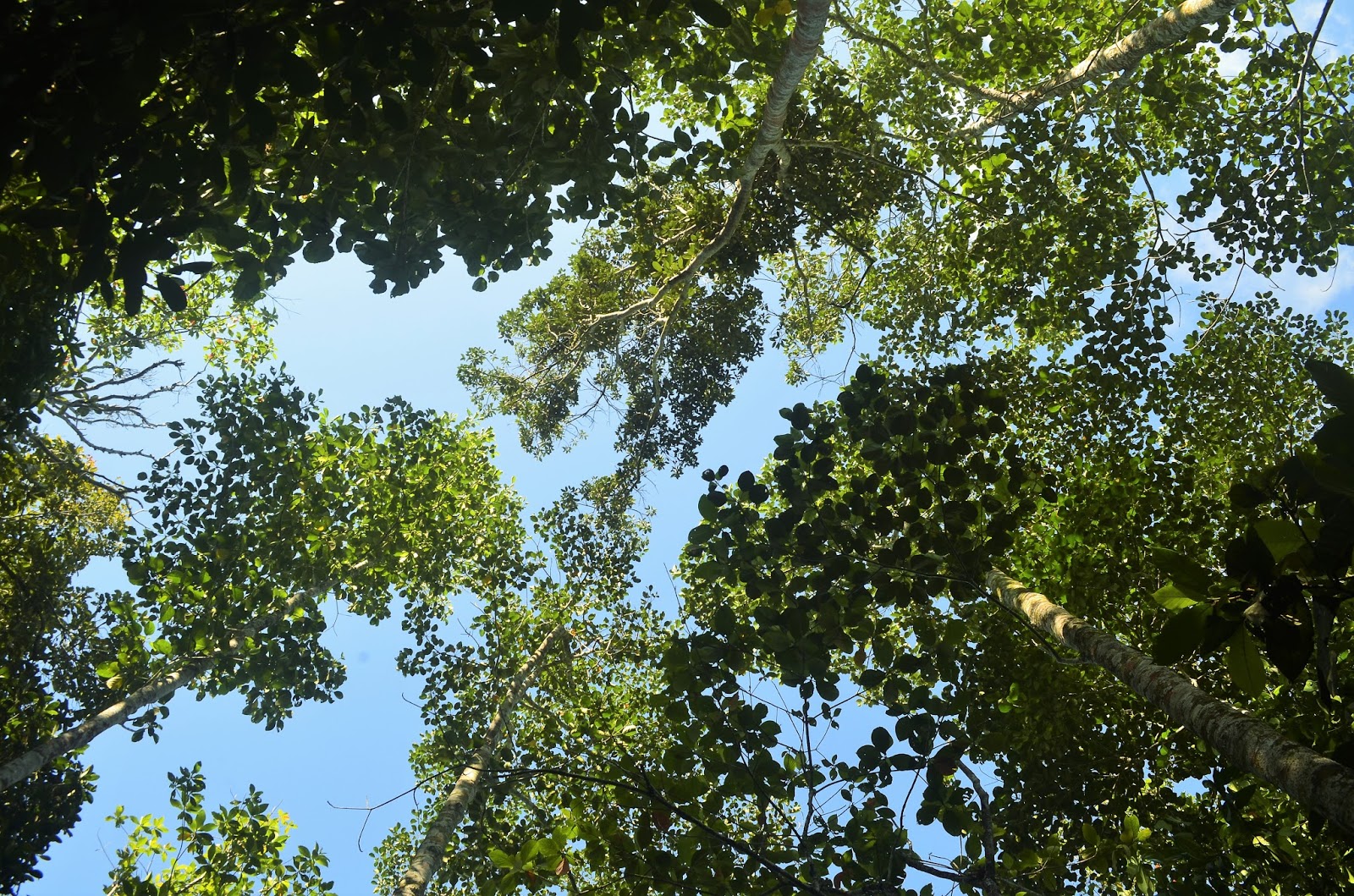
 I love the emergents.  For in the rainforest ecology of the park,  these super tall  trees rise above the landscape with a respectful 20 - 40 meters  high from the humid and leaves-littered forest floor below.  These are the forest wonders that delight me in my daily walks, their majesty proclaiming their age, rising above the competition and giving the iconic canopy and structure of the lowland dipterocarp forest.  These trees are retained as part of the agro-forestry practice of the nature park.  They are the answers that I worked hard on for many years now i.e. to re-live the green landscape of the village where I was born.  I am blessed daily to watch them grow,  close enough to walk below them, touch them and feel the ameliorating air below them. Trees are basic to any landscape, the taller the more original is the landscape.  This is so because we are living in the tropical rainforest zone on Borneo Island which contains one of the oldest and richest ecological diversity gems on this planet.  Life is really worth living with them as neighbours,
Zone D

Zone C

Monday, October 13, 2014

Sustaining the forest beyond

Cultivation of oil palm (as means) to sustain the rainforest ecology built around the existing original lowland dipterocarp forest eco-systems.
View of Zone G from Zone C, looking south

Botanic Island Two in the background
 There are two M's that can help me make the forest ecology of Kambatik Park a success.  First M is a strong MIND, a will if you care.   Second M  is the MEANS, without which you cannot develop and later maintain a nature park.  The park was fortunate because from its inception the existing preserve of original vegetation was not totally destroyed.  They were isolated and preserved as botanic islands of which there are currently four.  The oil palm cultivation were integrated around the islands , streams, swamps, slopes, roads and hills in order  not to destroy the original land form exceedingly.  Income from the oil palm harvests is the principal means to sustain the operation and maintenance of the forest ecology.  It is important to bear in mind that the real beneficiaries of the park are the wildlife and plants ecological diversity  and we humans need to re-learn to co-exist with them to really benefit from natural world, be it in agricultural productivity, tourism-related business or recreational activities.  Today when I take walks in the park, I feel so much peace with myself for having positively contribute to the  understanding and standing for nature.  The Kambatik Park is a first step in my journey to really take care of nature by seeing beyond the trees.
Plain areas as fallback positions in time of flash floods due to torrential rains
Natural and man-made forest eco-system integration

Eastern Crimson Sunbird brave itself to come out of the jungle to search for food on the cultivated garden areas of the park

Mormon butterfly in the Botanic Island Two

A walk in the park is the simplest means to commune with nature

Thursday, June 12, 2014

Happy with tall jungle trees

Tall trees at Botanic Island Four

 On the jungle floor, way down below the tall dipterocarpus trees I stumbled upon a mass of new seedlings emerging from the cover of dead leaves.  I am happy to see them  sprouting and living a new existence.  It was very easy to pull them out because the tap root of the seedlings have not really reached deep into the soil.  I collected some and would return later to collect more.  The park has a good collection of lowland dipterocarp forest trees.  Dipterocarp comes from the Greek word, "two-winged seed" - dis pteron karpos .  However some dipterocarp species have three, four or five wings seeds. The 'Meranti Tembaga' ( Shorea leprosula) which is one of the favoured species for timber has five wings.  Then there is another species popular among the natives of Sarawak because it is the source of the illipe nut called Shorea macrophylla (Engkabang - Iban). It is my intention to transplant these shorea species seedlings for posterity.  In the landscaping business, the well-known dipterocarps for urban tree planting are as follows: Shorea roxburghii - Meranti Temak Nipis (Malay); Hopea odorata - Merawan Siput Jantan - (Malay); Shorea sumatrana - Sengkawang.
Note the winged seeds providing interim food while the root system slowly develop to tap food from the jungle floor and soil.

Seedlings on jungle floor borne from four-winged seeds.
At the center is a dried specimen of the four-winged seed of the seedlings shown above.

Tuesday, May 27, 2014

Kambatik Park - an appreciation (Part 2)

The future happens here at the Kambatik Park

Eight years in days and nights of rain, sunshine, humidity and drought have gradually brought the park to its envisioned state.  It has become a sanctuary of wildlife.  A place where work is fun and joy to be.  A lowland dipterocarp forest environmental habitat enhanced with ecological diversity where oil palm farming is well-integrated into the culturally inspired native  agro-forestry practices.  It is here that I learn the meaning of ecopreneurship.  I am not the conventional planter  because I forever aim to  harvest 'green gold' together with a wealth of teeming wildlife every week in a month for the next 20 golden years (economic life of the oil palm trees) and more.   And this is made possible even without any single loan from the banking or financial institution in the development of the park since day one.  It is a fine example of where there is a will there is a way. 
I have answered the question that bugs and begs me. 
What is your contribution to the future, especially its environment and climate?  Is your contribution unique and of consequence?  I am getting ready to handover an environment where nature thrives ecologically and able at the same time to sustain itself commercially.  When all  the mainstream media currently report about  oil palm farming is the prevalence of  monoculture cultivation  and in its wake the destruction of whole forests, my experience has taught the contrary.  At the park oil palm farming is carried out in an eco-friendly manner.  It has passed the acid test of ecological diversity.  It is my hope that the authorities will see the model experimented here as iconic of the contribution of smallholders in the state in their safe practice of oil palm cultivation.  This model can make Sarawak into a destination with the broadest band of park lands and nature reserves  in Malaysia, if only leaders have the political will.
Overview of oil palm and agro-forestry integration - many more golden years ahead...

 This blog is testimonial enough on the practice of oil palm cultivation the eco-way, something that I would be pleased to pass on to my children and grandchildren and lovers of nature for posterity.  The future happens here at the Kambatik Park.

Friday, January 10, 2014

Zone G

Existing exotic 'cempedak' trees at top of the spur at Zone G are retained

 At the picture at left (inset) is seen a thick cover of exotic trees that were there about 60 years ago.  These fruit trees and bamboo stands are retained as part of the agro-forestry practices at the park.  The Zone G is the end part of the spur from a hilly range located south of the park.  Oil palm trees are planted all around the slopes of the spur.


Zone G, view looking south from Zone B...observe the slope of the spur which is planted with oil palm trees.


Oil palm trees planted on top of the spur...view looking south