Showing posts with label Zone B. Show all posts
Saturday, October 27, 2018
Thursday, April 19, 2018
Flash floods and some views of the park in April
![]() |
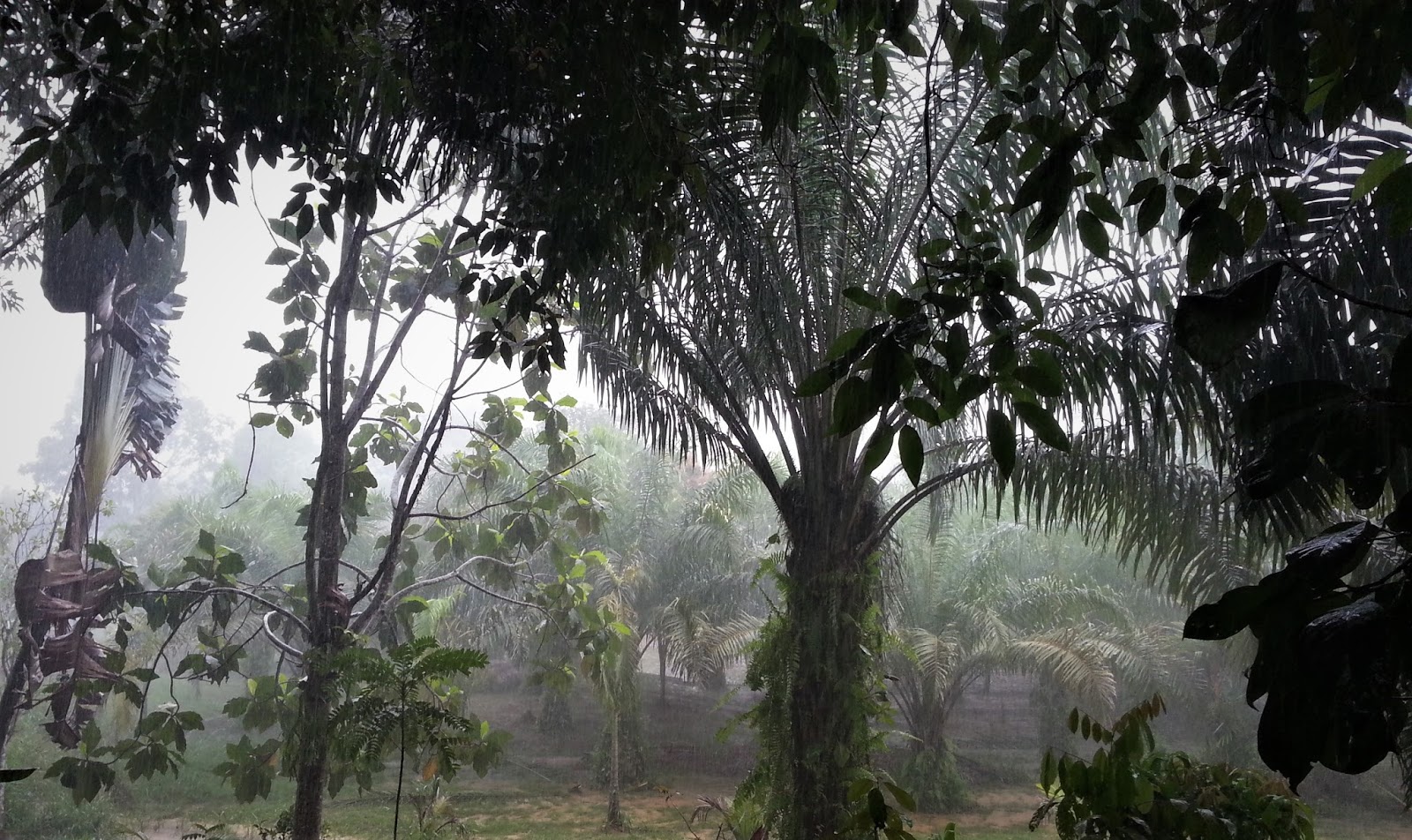
| Zone F in heavy rain. |
It has been raining heavily for the last three days (mainly nights). The parkland is situated on a very hilly area and is the headwaters of a stream, which for convenience I call the Kambatik stream. The heavy downpour would normally create flash floods. However, due to its hilly landscape the excess downpour would race downstream. This event is exciting to watch and offers some fine photographic moments.
After the floods, I walked up the Cempedak Hill and found a lone Plaintive
Cuckoo. This time it is the female of
the species, a lifer for me.
Here are some views of the park taken in April’18.
![]() |
| Flash floods at Zone F |
| Zone B |
| View towards Zone A, looking east, from Cempedak Hill (Zone G) |
Monday, September 5, 2016
Ladies, this plant is for you.
![]() |
| The centre oil palm tree (above) is where the Lipstick plant grows |
![]() |
| Near blooming stage |
![]() |
| The flower starting to full bloom. |
Tuesday, June 28, 2016
Ever free ferns from Kruak wetlands
| A mixture of 'Miding' and 'Paku Uban' ferns at Kruak Wetlands |
| Paku Uban (foreground) Miding (background , at left of picture) |
| Young leaves of Miding |
| 'Miding' ferns freshly collected from Kruak wetlands |
| Miding served with rice |
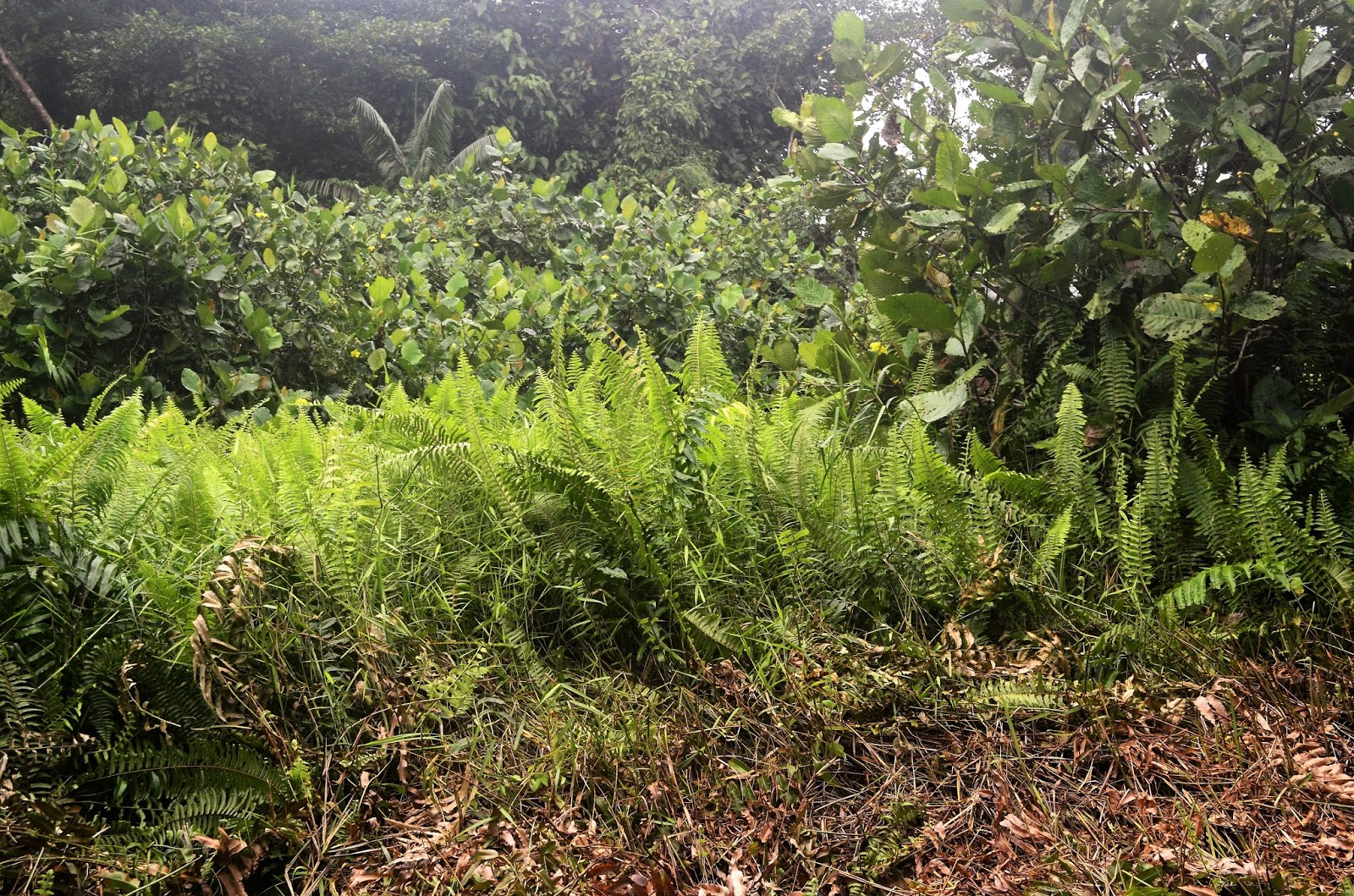
| Kruak wetlands Zone B |
Sunday, January 10, 2016
Green umbrella and practice green
| Big enough for a 'Practice Green' Zone B |
| Zone B - 'rough area' |
| Shade and light under the green umbrella of oil palm fronds Zone B |
Sunday, October 25, 2015
The wild Phaius orchid is flowering
| Keruak wetlands at left and back of picture |
| Wild orchid of the Phaius variety Nearby the Keruak wetlands area, Zone B. |
| White spores revealed after the mature pods are opened. Zone B. |
Thursday, January 22, 2015
New terrestrial orchid found
Found a new terrestrial orchid with upright flower spikes at Zone B yesterday. The area is at the edge of the Kruak wetlands. The damp earth covered with rotting branches, fronds and leaves have provided the ideal conditions for this new discovery. At this point of writing I'm still unsure what species of wild orchids it belong to. Could it belong to the Nephelaphyllum tribe of which the Tania is a likely candidate. Or it could be placed under the Phaius tribe of which two genus are relevant i.e. Phaius and Calanthe. I'll study in further detail this new find and will revert in future posting its likely nomenclature. What excites me is its colourful sepals that are a light brownish purple. The two petals are whitish and the lip is a nice subtle brownish purple with attractive orange brown centre leading to its reproductive parts. I have reserved a name for it....
Sunday, October 5, 2014
Birding at Paya Point
![]() |
| Female Brown-throated Sunbird feeding its young at Paya Point |
![]() |
| Female Brown-throated Sunbird |
![]() |
| View of Paya Point, looking east. Note the tall heliconia plants in the middle of the swampy area. |
![]() |
| Thickets of grasses, ferns and creepers are nesting grounds for Munias, White-breasted Waterhen, butterflies, dragonflies, frogs etc.. |
![]() |
| Chest-nut Munia foraging for grass seeds at Paya Point |
Monday, July 14, 2014
In Plain Sight - Provinsi Yellow Palm (Part 8)
![]() |
| A large specimen of the Yellow Palm (Dypsis lutescens) Syn : Chrysalidocarpus lutescens Note the clustering habit. New canes are produced from base of the clump as older ones mature. |
![]() |
| Golden stems and leaf stalks View looking north |
![]() |
| View looking south |
![]() |
| View looking south |
![]() |
| View looking south Location : Provinsi Yellow Palm, Zone B. |
Thursday, July 10, 2014
A Prinia preview
![]() |
| Perenjak Padi (Malay) - Prinia flaviventris Location: Zone B |
The Yellow-bellied Prinia is a resident of the park. Despite that status, to get close to it has been a big problem for me. However, today I am lucky. Out of the blues it decided to give me a most pleasurable photoshoot session. The prinia has one of the loudest calls among the small birds at the park. It doesn't fly straight and when it fly the wings flap loudly. I understand that the Yellow-bellied Prinia is the only prinia on this big island of Borneo. Its music to listen to the singing of the prinia.
![]() |
| Singing on a tall stem... |
![]() |
| Singing from the branches of the oleina tree.. |
![]() |
| The presence of grassland or grass reserves proves useful as perches for the prinia.. Location : Zone B |
Monday, April 28, 2014
Sambar Murai Gila or the Pied Fantail
![]() | |
| Sambar Murai Gila (Malay) - Ped Fantail Location : Zone B |
Living in a lowland dipterocarp forest one is able to find the "Sambar Murai Gila" comes out from the jungle to checkout the forest fringes. It is only one of the many fantails in Sarawak that has the habit of coming close to human habitation. Today it came close enough to show off its beautiful fantail. The tail feathers have a broad white tip that are of progressive length and when fanned out form a semicircular-shaped tail. Today it was busy moving about the branches of the Shrubby Dillenia to devour some red ants.
Wednesday, January 8, 2014
A flirting fantail with suicidal downdropping behaviour
![]() |
| Pied Fantail (Rhipidura javanica) |
I have not been able to really zoom in to this bird until recently when I noticed their particular behaviour at close range. One day I was at the fruiting Jackfruit tree with a few of the fruits overripe and partly rotten. The fruits therefore attracted a lot of insects chiefly the fruit flies. The name fantail describes its behaviour well. It likes to prance and dances on the branches and twigs. It opens its fantail wide in a flirting fashion. But one behaviour that attracts me to this bird is its attempt at suicidal flight where it would downdrop its wings and tumble down only to rise up in quick succession to repeat its dances and prances.
![]() |
| Note the characteristic white throat and quite long tail. |
![]() |
| The Pied Fantail is a lowland forest resident in Bintulu and is the only species in the family that is known to come close to human habitations like gardens and plantations. |
Subscribe to:
Posts (Atom)