Showing posts with label Dipterocarp forest. Show all posts

Wednesday, May 4, 2016

Loving the emergents

Botanic Island One

Botanic Island One
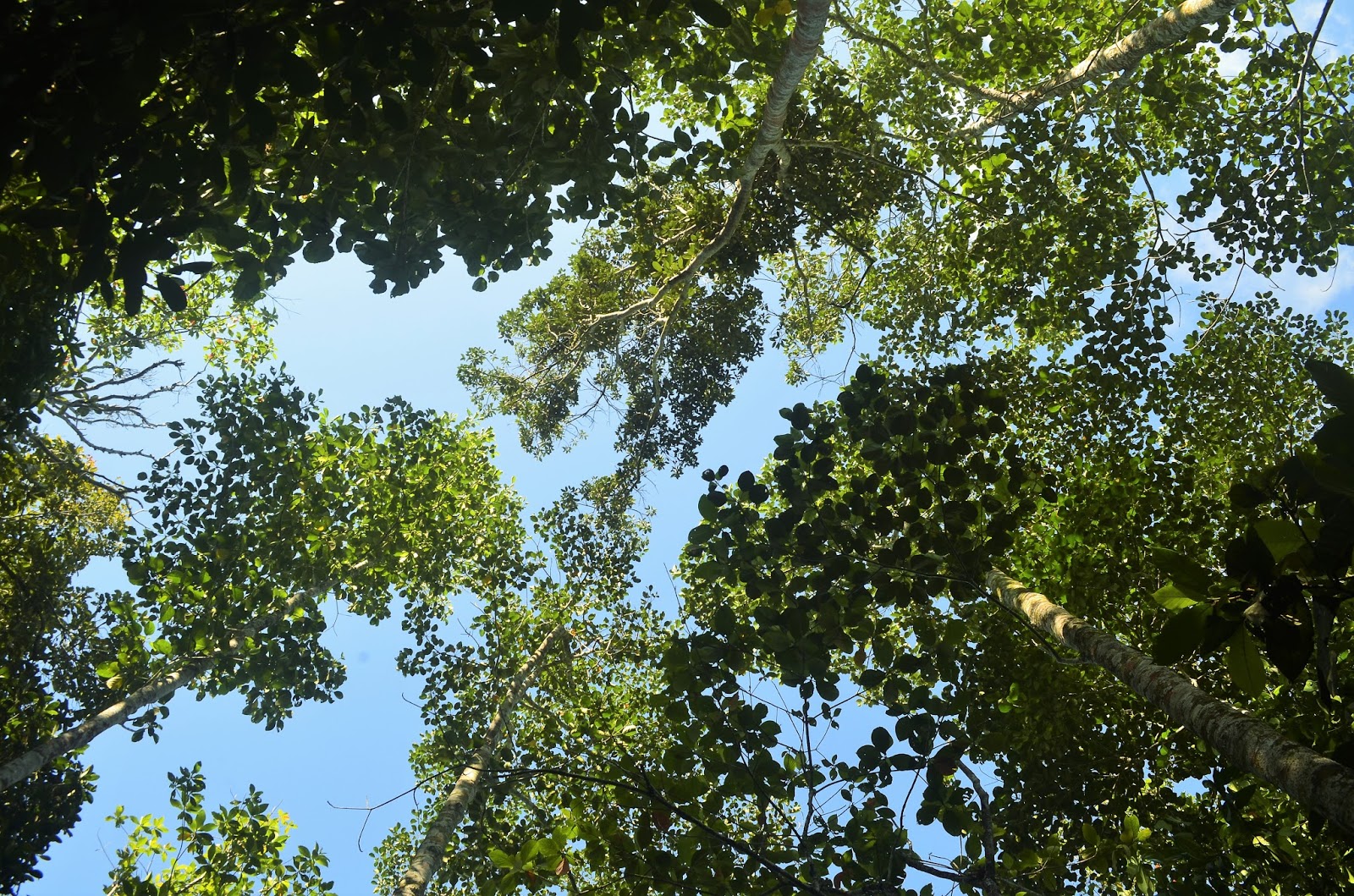
 I love the emergents.  For in the rainforest ecology of the park,  these super tall  trees rise above the landscape with a respectful 20 - 40 meters  high from the humid and leaves-littered forest floor below.  These are the forest wonders that delight me in my daily walks, their majesty proclaiming their age, rising above the competition and giving the iconic canopy and structure of the lowland dipterocarp forest.  These trees are retained as part of the agro-forestry practice of the nature park.  They are the answers that I worked hard on for many years now i.e. to re-live the green landscape of the village where I was born.  I am blessed daily to watch them grow,  close enough to walk below them, touch them and feel the ameliorating air below them. Trees are basic to any landscape, the taller the more original is the landscape.  This is so because we are living in the tropical rainforest zone on Borneo Island which contains one of the oldest and richest ecological diversity gems on this planet.  Life is really worth living with them as neighbours,
Zone D

Zone C

Sunday, March 1, 2015

The forest fringe

Forest fringe of a lowland Dipterocarp forest
Location: Zone C, adjacent to Lada Hill

Red-eyed Bulbul resting
on the fronds of a Nibong palm
 It is vital to keep a forest fringe around the Kambatik park.  This is to enable the continuation of green passageways for the wildlife.  They act as fallback sanctuaries to the park.  In its ecosystem thrives nature's denizens that will want to familiarise themselves to the park.  Some may retreat at night in the forest cover for rest but will soon come out during daylight to scavenge or prey for food at the park.  The forest fringe is a transition landscape and is a site  inhabited or regularly frequented by a rich assortment of wildlife, from ground level to top of canopy, or somewhere in between too.  Most interesting at the park here is the phenomena of the Sambar deer that depend on the forest cover to wander in the night and come out to visit the park areas to enjoy the water from the streams and ponds and to eat some of the cultivated leaves here, chiefly the Tapioca leaves, young leaves of the Cempedak, some Banana species,  grasses and ferns growing on  the oil palm tree trunks.
Plantain Squirrel hunting on the forest fringe

A Monitor Lizard finds temporary comfort on a tall tree trunk on the forest fringe

Plants of botanical interest at the forest fringe
At center is the Staghorn fern

Thursday, June 26, 2014

Less is more


 I am a fortunate guy.  The park is my lab for understanding nature in my private time and place.  Living in a lowland dipterocarp forest environment has provided me with the opportunity to internalize the global concerns of global warming, rainforest destruction, disappearing natural wildlife and untoward corporate greed.  For example the capitalist model of massive consumption has brought much destruction of nature.  In oil palm monoculture, whole original forests in Sarawak are stripped to ground zero only to be replanted with a single oil palm crop.  This unimaginative capitalist urge in corporations is largely driven by quantitative results in the name of  maximum profits.   But in the Kambatik philosophy less is more.  Here oil palm is well-integrated into the existing agro-forestry practices that resulted in increased bio-diversity, more value to the land as in potential economic spinoff in eco-tourism.  In particular this concept can uplift Sarawak into the only state in the world to possess a string of  park lands and nature reserves that can sustain itself through oil palm integration.  Imagine the total length of 800 km of Sarawak's country side situated along the trunk road turned into a continuous  band of wildlife, rainforest biodiversity, eco-tourism centers and the longest learning lab in the world.  This is my hope.
Oil-palm integration into native agro-forestry practices...

A pair of Brown -throated Sunbird finds home at the Kambatik Park...