Showing posts with label Fern trail. Show all posts

Tuesday, June 28, 2016

Ever free ferns from Kruak wetlands

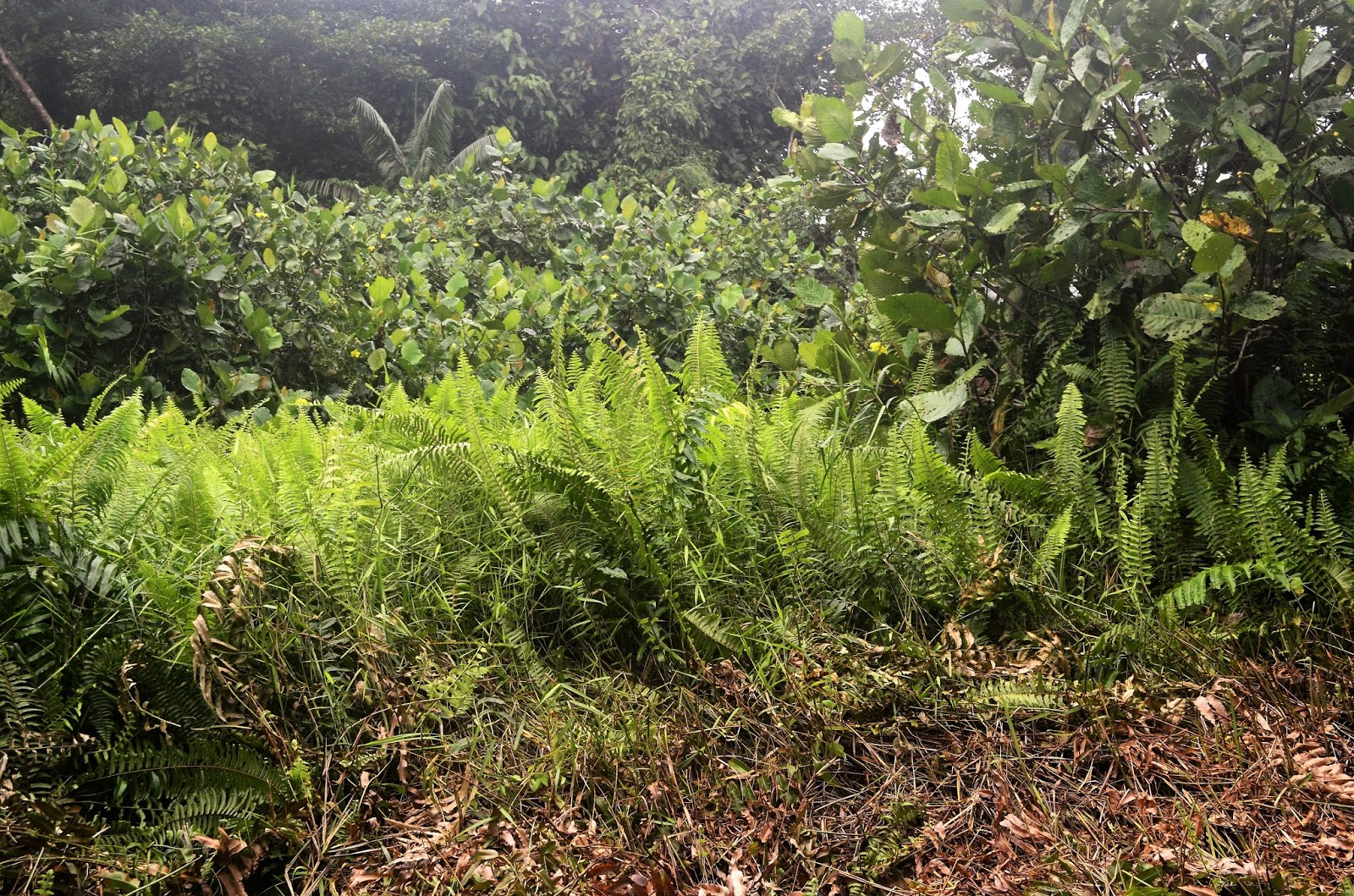
A mixture of 'Miding' and 'Paku Uban' ferns at Kruak Wetlands

Paku Uban (foreground)
Miding (background , at left of picture)
 You can enjoy plucking  free ferns any day of the week within minutes of walking.  This phenomenon is made possible by developing an area of about half an acre within the park focused on the 'cultivation' of edible ferns.  Two species of ferns that grow naturally here are the Miding ( Stenochlaena palustris) and the Paku Uban (Nephroplepsis acutifolia).  These ferns love bright sun, damp ground mixed with tall grasses as natural support.  At the moment I am developing part of the Kruak wetlands specifically for this purpose.  I have blogged a fair bit about these ferns and how to cook them.  Please follow this link to know how...>>>>http://kambatikpark.blogspot.my/2014/04/wonder-fern-at-park.html
Young leaves of Miding

'Miding' ferns freshly collected from Kruak wetlands

Miding served with rice
Kruak wetlands
Zone B

Friday, May 27, 2016

Free, fresh and fulfilling fern

Lunch at the park.

A small basketful of Miding
 It is one of my favourite food at the park.  It is free, fresh and fulfilling.  This morning I collected the 'Miding' ferns ( Stenochlaena palustris) in ample quantities for a decent lunch (see inset).  These ferns grow wild and naturally in damp areas near the Kruak wetlands.  The quantity I collected this morning would have cost me RM 2 if I were to buy it at the local 'tamu' ( jungle produce market).  The miding ferns have first of all to be fried with the famous shrimp paste of Bintulu called 'belachen' in the local Melanau dialect ( Belacan - Malay) .   The paste is pounded with other ingredients like anchovies, red chillies etc. Once fried you need to consume the freshly cooked miding  with hot rice and perhaps a little fish meat. That's the fun of it.  Quick to get, quick to eat.  Very fulfilling. Thanks to nature.
Free, fresh and fulfilling fern.

Saturday, March 7, 2015

Tie a staghorn on the old Lumok tree

Lumok tree (Artocarpus odoratissimus) is seen at center
Location : Zone C

Staghorn fern ( Platycerium coronarium  ) secured on the branches.
The park has a considerable number of Staghorn ferns that grew naturally in the Botanical Islands and well-preserved for posterity.   I have accumulated a number of plantlets over the years and tender them till they grow reasonably big.  Today I decided to place one on an old Lumok tree.  The above pictures show the result of the work.

Tuesday, May 20, 2014

Hot on heels on ferny trail (Part 4)

Bird's Nest Fern - Asplenium nidus
Location : Botanic Island Two

 The Bird's Nest Fern is seen in abundance at the park.  Young ones start life early at the rotting cut bases of the oil palm fronds from which they can be easily removed and nursed elsewhere.  However to see them hugging jungle tree trunks at low level is a prized reward when walking the jungle. I have seen many examples of these ferns used extensively and effectively as landscape plants.  They could be grown in big pots, grown on urban trees, arranged on ground in formal or informal settings.  Here's some more images to show their landscaping uses.... 
Young Bird's Nest Fern growing well on decaying cut bases of oil palm fronds
Location : Zone C

Asplenium nidus arranged in formal setting

Asplenium nidus on urban tree

Asplenium nidus in natural and informal setting..
Location : Botanic Island One

Sunday, May 18, 2014

Hot on heels on ferny trail (Part 2)

View of Kambatik Park, from Zone G looking south - showing the yellow flushes of the 'Balem' tree.

Dragon scales 0r Duit-Duit (Malay)
(Drymoglossum piloselloides)
 We have tall trees at the park.  Been here for more than 60 years ago.  In such an environment there are lots of shade below the canopy and the trunks and barks of these trees are natural hangouts for the epiphytic ferns.  One such example is the Dragon Scales or what Malays call 'Duit-Duit' - literally to shown the shape of the leaves which resemble coins.  In Malay, duit means money and in this instance is small money, just coins.  This fern has adapted well to live on branches and its presence pave the way up for other ferns to create a community of ferns.  They could also be joined by other plantlife like the many varieties of miniature wild orchids (see picture below).
A small commuinty of ferns and wild orchids.
Location : Zone C
The cut bases of oil palm fronds are ideal places for ferns to grow because of its ample moisture trapped in the rotting fibrous medium.  In the above picture is shown the brownish roots of the Rabbit's Foot Fern that fixes itself on the rotting vegetative matter of the oil palm trunks. 

Disc Stag's Horn Fern ( Platycerium coronarium)
 An exotic looking fern that is easily found attached to tall trees at the park is the Disc Stag's Horn Fern (Platycerium coronarium).  Nowadays it is common to see them hanging on the branches of rubber trees,  old jungle trees in the forest or even in urban environments on wayside trees like Rain trees which are planted at car parks, open spaces and green lungs of the urban towns.
CU of the leaves of the Disc Stag's Horn Fern.
Location : Botanic Island One, Zone D.

Hot on heels on ferny trail (Part 1)


Two main fern species abundantly found around the pond are 'Miding' and 'Paku Uban'
Location : Waterlily pond, Provinsi Manila @ Zone B

Paku Uban (Iban) - Nephrolepis biserrata
 Ferns are fascinating plants because even though they are non-flowering they still can reproduce by spores which lie under their leaves.  They are delicious and I have blogged a fair bit about many vegetable ferns of Sarawak.  There are about 500 species of ferns in Malaysia and Sarawak for that matter.  Ferns can survive many kinds of climatic environments.  In the park they are species that have adapted well to open sun and open spaces  whilst others prefer moist and shady areas.  This new Fern Trail project will gather as many different species of ferns as possible.  Below are some examples....  
Miding (Stenochlaena palustris)

Lycopodium cernuum - Nodding Clubmoss
Location : Zone G


Lycopodium cernuum - Nodding Clubmoss  Location : Zone G
Dicranopteris linearis - Resam (Malay)
Location : Zone I


Dicranopteris linearis - Resam (Malay) or commonly as Bracken fern.
Location : Zone I

Friday, May 16, 2014

A Fern trail for the park

Wild ferns for vegetables sold at Tamu or jungle produce market in Bintulu town.

Miding (Stenochlaena palustris)
 I am inspired today to start a new project called the 'Fern Trail'.  This trail will be about one kilometer long and will enable the  enthusiast to discover ferns on open spaces, valleys, hills, streams and jungle environments.  The list of vegetable ferns that grow naturally here is as below:
1) Stenochlaena palustris - Miding (Malay)
2) Diplazium esculentum - Paku Ikan (Iban)
3) Nephrolepsis biserrata - Paku Uban (Iban)
4) Helminthostachys spp. - Sumbok Gana (Iban), Tongkat Langit (Malay)
5) Blechum orientale - Paku Kelindang (Iban)

Besides the more popular vegetable ferns, other types of ferns could  be grown, transplanted and re-grouped in dramatic and interesting presentations.  There shall be established 5 fern stations along the trail and the biggest stations to assume a fernery.  The list of ferns to be transplanted or planted gradually are as follows:
1) Asplenium nidus - Bird's nest fern
2) Asplenium tenerum
3) Asplenium longissimum
4) Adiantum fabellulatum - Maiden's Hair
5) Athyrium esculentum
6) Blechnum orientale - Paku Ikan
7) Cyathea latebrosa - Tree fern
8) Davallia denticulata - Rabbit's Foot ern
9) Dicranopteris linearis - Resam
10) Drymoglossum piloselloides - Duit-Duit
11) Dipteris conjugata
12) Dipteris lobbiana
13) Gleichenia truncata
14) Platycerium coronarium - Disc Stag's Horn fern
15) Pityrogamma calomelanos - Silver Fern
16) Psilotum complanatum
17) Schizaea dichotoma - Grass Fern
18) Stenochlaena palustris - Miding

The fern trail project should keep me very busy for about three months from today.
Platycerium coronarium or Disc Stag's Horn Fern
Location : Botanic Island One, Zone D

Bird's nest fern - Asplenium nidus

Oil palm tree skirted with variety of ferns
Location : Zone C