Showing posts with label Food. Show all posts

Saturday, July 22, 2017

Physalis are a plenty

Ripe fruits of Physalis minima or 'Letup-Letup' in Malay.

There are plenty of ripe berries of the Physalis minima at the park right now.  This plant though imported a few of years ago to the park seems to like the environment here and are 'self-propagating' naturally through its ripe seeds.  It requires very little maintenance though a good dose of fertiliser would surely make the stems stout and more fruit-bearing.  When available the berries make good menu for vegetable  salad for they taste very much like tomatoes (see below). 


Tuesday, June 28, 2016

Ever free ferns from Kruak wetlands

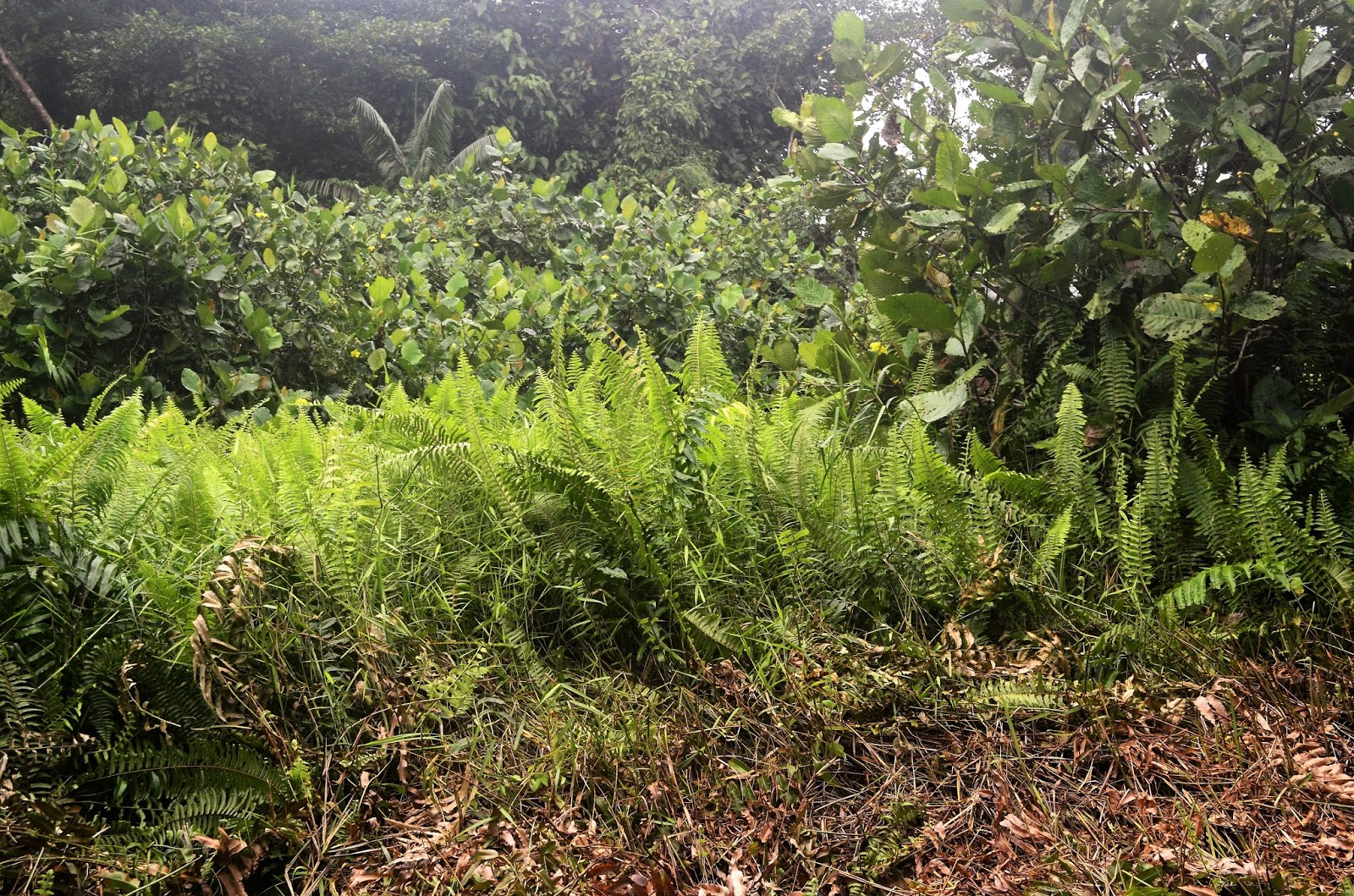
A mixture of 'Miding' and 'Paku Uban' ferns at Kruak Wetlands

Paku Uban (foreground)
Miding (background , at left of picture)
 You can enjoy plucking  free ferns any day of the week within minutes of walking.  This phenomenon is made possible by developing an area of about half an acre within the park focused on the 'cultivation' of edible ferns.  Two species of ferns that grow naturally here are the Miding ( Stenochlaena palustris) and the Paku Uban (Nephroplepsis acutifolia).  These ferns love bright sun, damp ground mixed with tall grasses as natural support.  At the moment I am developing part of the Kruak wetlands specifically for this purpose.  I have blogged a fair bit about these ferns and how to cook them.  Please follow this link to know how...>>>>http://kambatikpark.blogspot.my/2014/04/wonder-fern-at-park.html
Young leaves of Miding

'Miding' ferns freshly collected from Kruak wetlands

Miding served with rice
Kruak wetlands
Zone B

Friday, June 24, 2016

Letup-Letup or Lesser Bladder Cherry (Physalis minima)

Lesser Bladder Cherry or "Letup-Letup" (Malay)
Physalis minima
Family : Solanaceae - Tomato family

Fruit and flower
 There are plenty of 'Letup-Letup" fruits now at the Butterfly Garden area.   The more well-known variety is called the 'Chinese lantern', the variety we have here is the 'Lesser Bladder Cherry' which is the lesser Chinese lantern.
It is a short-lived herb bearing edible berries which are yellowish when ripe.  These berries taste like tomatoes and are hidden inside the inflated calyx resembling a delicate Chinese lantern.
This plant could be planted as part of edible landscaping or Sara landskap (Malay) in the Malaysian garden
I have done a photo rendart (i.e. photo rendered digitally artistic) below on this plant.
Photo rendart by MOOD, June'16.

Friday, May 27, 2016

Free, fresh and fulfilling fern

Lunch at the park.

A small basketful of Miding
 It is one of my favourite food at the park.  It is free, fresh and fulfilling.  This morning I collected the 'Miding' ferns ( Stenochlaena palustris) in ample quantities for a decent lunch (see inset).  These ferns grow wild and naturally in damp areas near the Kruak wetlands.  The quantity I collected this morning would have cost me RM 2 if I were to buy it at the local 'tamu' ( jungle produce market).  The miding ferns have first of all to be fried with the famous shrimp paste of Bintulu called 'belachen' in the local Melanau dialect ( Belacan - Malay) .   The paste is pounded with other ingredients like anchovies, red chillies etc. Once fried you need to consume the freshly cooked miding  with hot rice and perhaps a little fish meat. That's the fun of it.  Quick to get, quick to eat.  Very fulfilling. Thanks to nature.
Free, fresh and fulfilling fern.

Saturday, September 19, 2015

The Jering tree and fruits

The Jering tree is partly seen at middle ground of picture
Location : Zone G

Jering fruit (seed)
The Jering (Pithelobium lobatum) tree that is located beside the road at Zone G is a large tree.  Today I started to clear the undergrowth around the tree in order to make way for convenient access to the tree. I have not checked this tree earlier and to my surprise it is bearing fruits.  In Bintulu, the Melanau elders love to boil the Jering fruit, which is this case is actually the seed (see inset) and eat it together with fresh grated coconut in palm sugar.   I love Jering for 'Ulam' (Malay) which is akin to eating it as salad.  To make the Jering more palatable as a salad, it is better to eat it with a prepared paste of Bintulu 'belacan' pounded with anchovies, a bit of red chilies and ginger.
The Jering fruit is believed to be able to cure high blood pressure.
Clearing work around the Jering tree.


Friday, September 18, 2015

Fritters from a 70 years old tree

Serve the fritters hot for afternoon tea.
Today I have great respect to a 70 years old Cempedak tree.  The tree has been standing here before I was born.  The beauty about this tree is that it is still bearing fruits that are exceedingly sweet.  It is indeed a privilege for me to enjoy its fruits taken fresh or as fritters.  Here's a guide on cooking  Cempedak fritters.  First prepare a batter comprising of wheat flour and water (see inset) .  Heat up the oil palm cooking oil in the frying pan in medium flame.   Throw in the Cempedak fruits covered in batter into the frying pan and wait till the colour turns brownish, to indicate that it is sufficiently cooked.  This would take between 10 - 15 minutes.  Serve hot.  Cempedak fritters are great for afternoon tea.
When the fritters appear brown it's an indication that they are sufficiently cooked.
Fresh Cempedak fruits from a 70 year old tree

Wednesday, September 3, 2014

Bamboo shoots for lunch

Bamboo shoot forcing itself out from surrounding little of dried bamboo leaves
Location : Zone G

Bamboo shoot removed of sheaths
 I meant to post this yesterday but due to very poor internet connection last night I can't even send a picture in an hour!  But the fun of the story kept me alive for another day. This morning  at last the bamboo shoot story is told. But how to eat the bamboo shoot?  For the cooking section I refer to my wife.  I collect the shoots and she does the rest.  First, cut the outer thick skin (sheaths) of the shoot till you reach the inner core of the shoot as shown at the inset. Then cut it further into smaller bite pieces as shown below.  Then boil them for about an hour to soften. Prepare a paste of Belacan with red chillies, onions and dried prawns.  Keep cooking the bamboo shoot mixed with coconut milk and the paste for about 15 minutes.  When done and well cooked, serve hot with salted fish.  Eating them is like heaven on earth.  Thanks to the Almighty for giving us the joy of eating nature's pure food.
Boil to soften for 30 minutes

Cook the shoots mixed with coconut milk, Belacan paste (pounded with dried prawns, red chillies and onions) for about 15 minutes

Served hot with rice and salted fish

Wednesday, April 30, 2014

Wonder fern at the park

Miding (Malay) - Stenochlaena palustris growing on the oil palm trunk

 There are many types of ferns at the park, some have epiphytic habits.  The Miding is one wonder fern here that grows luxuriously on wet areas as well as on palm trees.  Today the Miding is a 5-star vegetable that is served at many 5-star hotels or restaurants in Sarawak.  It is about the healthiest vegetable  at the park because it grows naturally without receiving fertiliser or pesticide.  Here's how to eat this fern vegetable. 

Collect as many young Miding stalks as you can (above).  They may vary in size and age, but that does not matter.  Separate the hard section of the leaf stalks to be thrown away as shown below.
How to cook the Miding:  Firstly, prepare a 'sambal' paste by pounding shallots, garlic, anchovies and 'belacan' or shrimp paste and chilies.  Secondly, stir fry the paste for about 2 minutes with a little bit of cooking oil.  Thirdly, put in the Miding vegetable and sprinkle salt to taste.  Cook for only two minutes because this type of vegetable gets cooked very fast.  Finally, served hot with rice. 
The fern Miding vegetanble cooked in sambal belacan paste, or what the Malays called "Miding tumis belacan".

Friday, January 3, 2014

The food web

Botanic Island One - view from mid-hill footpath looking south

 In the tropical rainforest, there is a complex web of food chain.  Like today I noticed one carpenter bee that got trapped in the spider web.  It was slowly being devoured by the spider. The leaves in a forest capture solar energy and they contribute to the supply of food to various insects and caterpillars. As  herbivores,  caterpillars and grasshoppers are in turn eaten by carnivores like spiders and other birds.  These carnivores in turn die and decay providing food for earthworms and all other life in the soil.  The process of decay includes decomposition work by bacteria.  Fungi invade a fallen dead tree from the outside .  Some of these fungi are edible.  The 'Kulat Perut Manok' or Clitocybe fragrans is a popular fungi that is taken by many people in Sarawak.  It is my wish the the park retain as much of this complexity in order to sustain a better future for the wildlife and nature in this tiny spot on planet Earth.
Carpenter bee devoured by a spider.

Dragonfly feeds on mosquito larvae
Edible mushroom locally known as 'Kulat Perut Manok' (Clitocybe fragrans) harvested from a fallen dead tree.

Kulat Perut Manok (Iban) - Clitocybe fragrans growing on a dead ficus trunk.

Thursday, January 2, 2014

A fruity lunch

Sweet and succulent deep yellow to orange Chempedak fruits.
At the foreground are the oil palm fruits.

 The very sweet Chempedak madu is just ideal for dessert.  This variety is extra sweet and succulent.  In the above picture is shown the 'sawit' fruits (oil palm fruits) as part of presentation, though when boiled the sawit fruits can be eaten just as well.  Ok, there is such a thing as a fruity lunch.  So we have today the fruit salad Malaysian style which is made of sliced 'sengkuang' fruit or jicama and slices of  'timun' or cucumber.  These are mixed well with the Malaysian salad paste called 'sambal rojak'. The whole dish is thus referred to as 'rojak buah-buahan' or fruits rojak.
A fruity lunch plate consisting of 'Chempedak madu' and  'Rojak buah-buahan' (Malaysian fruit salad)
The Chempedak madu is for dessert.

Tuesday, October 15, 2013

The making of chicken cooked in bamboo or 'Ayam Pansuh'

The making of chicken cooked in bamboo..
The above picture is half of the story...slices of chicken mixed well with other ingredients prior to inserting them into the bamboo

Bamboos like these can be bought at
'Tamu' or jungle produce market for
Rm 2 each in Bintulu.
 This is a very special dish popular among the Bidayuhs of Sarawak - the making of chicken cooked in bamboo.  This method of cooking is called 'Pansuh', thus chicken cooked the Pansuh way.  Here's how it is done step by step.
Ingredients:
You need young tapioca leaves, bamboo, lemon grass, garlic, kantan (torch ginger) buds or flowers, shallots, chillies, salt, and slices of chicken meat.


Chicken sliced into small pieces

Young leaves of the tapioca - these are mixed and cooked as vegetables and to cover the top of the bamboo to help indicate whether the chicken is well-cooked i.e. when the young leaves turned soft and yellowish

Shallots and chillies are pounded into a paste

Mix the pounded paste with the chicken meat, crushed lemon grass and garlic and flowers or buds of the kantan (torch ginger)

 The next process is most interesting because it involves inserting the chicken and ingredients into the bamboo and then to stand the bamboo over a fire to cook.  Keep adding wood to the fire to allow for cooking about one hour.  Within that hour, turn the bamboo around to avoid over-burning of the bamboo.  The process of slow burning the bamboo is complete if you notice the tapioca leaves turning yellowish.     
The bamboo needs to be turned around to allow for consistent heating  and to prevent over-burning of  the bamboo which may result in damage and thus leaking of the chicken 'soup'

Young tapioca leaves turn yellowish to indicate the chicken is well-cooked..
Remove the contents of the bamboo and served the cooked chicken hot....

Served Pansuh ....yummy,yummy,yummy...
(Note : Compliments to the chef...my yours truly)