Showing posts with label Wildlife photography. Show all posts

Thursday, March 19, 2020

Walk in the park and Red Stink Bug

The Kambatik Park, Bintulu.
1 Feb'20.
I take today's Saturday the easy way. Walked around the park admiring the jungle greenery and anything that moves. But it was something that kept quiet but brightly coloured that attracted me. The Red Stink Bug was an excellent photoshoot candidate. Others in the line-up were the plumeria flower and the watery Rose Apple ( Jambu Air).
Red Stink Bug, 1 Feb'2020.


Malay Apple, 
( Note: This is a reposting from my FB account, dated February 1, 2020.)

Saturday, December 15, 2018

Coming closer to the Crested Serpent Eagle.


Sunday is a good day to enter the jungle to discover more things or just looking for surprises. Today's excursion was rewarded by a closer view of the Crested Serpent Eagle. The preserved nature at the park is a favourite hunting ground for the eagle. The smallest raptor, the Bornean Falconet is a frequent visitor. The Crested Serpent Eagle however is a raptor or a bird of prey that is among the large - sized raptors that are seen and heard often as they encircle the park from far above the canopy of trees and uttering their distinctive shrill whistling call...wheeat...wheeatt... The eagle is attracted to the abundance of squirrels, lizards and small birds here


(Note: This story is a re-post from my facebook, 4 November'18)

Saturday, October 27, 2018

A Brown Dragonfly


For the record, I stumbled upon a brown dragonfly which I have not seen before in the park.
Location : Zone B, at the wetland or swampy area. 

Saturday, June 23, 2018

Eco-marketing the Kambatik Park through FB


A short reflection.
I have great liberty in using FB to spread the word around the world about the Kambatik Park and connecting the name 'Bintulu' to it. It is not merely marketing the park as an ecological niche but also the name Bintulu. That's killing two birds with one stone. More than that, I enjoy contributing original experiences, photographs and design work. The park has given me vast opportunities to combine my various interests (and passion) in plants, wildlife, nature, beauty, design and planning a wildlife sanctuary. My time spent at the park for more than 12 years now has been most fulfilling and an important milestone in my life.
To see more examples of the FB cover pages please follow this link....>>>>https://kambatikpark.blogspot.com/…/label/FB%20cover%20pages
(This is a reeposting from FB, 23 June'18)

Saturday, April 7, 2018

The Large-tailed Nightjar has laid two eggs.


 Ssssshhhhh…..now you see it, now you don’t.  The Nightjar is still around and what a surprise – it is settling on two eggs!!

The Large-tailed Nightjar has always been a permanent resident of the park.  Here they hunt for insects and  produce a familiar garden call which sounds like ‘tok,tok,tok’.  The sounds can be heard every day here at dusk and dawn and throughout the night.

The Large-tailed Nightjar (Caprimulgus macrurus ) has a black bill and a body that is very well camouflaged with its preferred environment of open grassland.  It does not build the typical nest and would lay its eggs on bare ground.  The eggs (see inset)  as if by rule are two in numbers and are blotched.


Saturday, March 10, 2018

A monitor lizard at Kruak wetlands

Monitor lizard basking at the edge of Kruak Wetlands
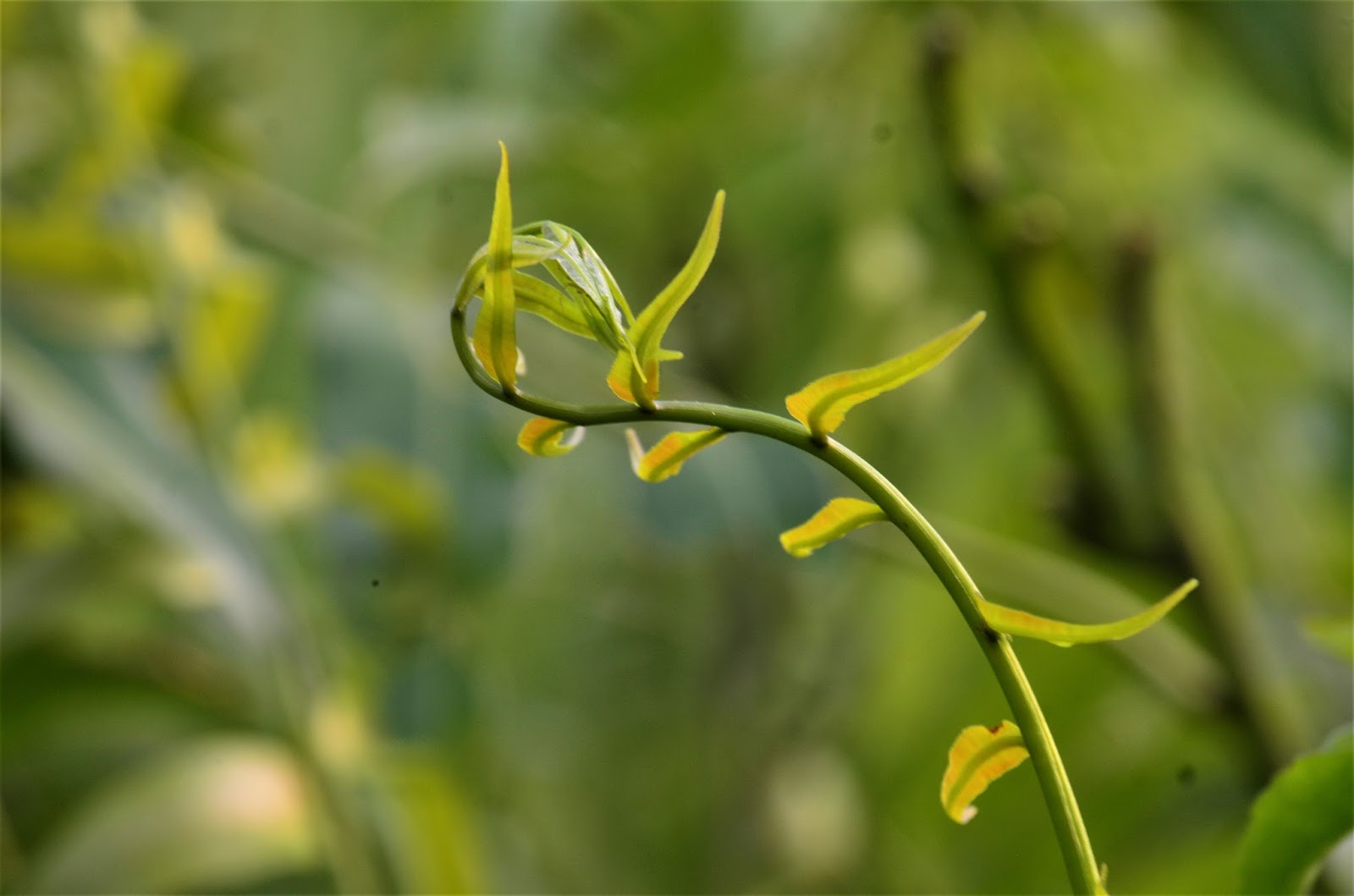
Edible young 'Miding' fern.
The Kruak wetlands has  brought a big surprise today with the sighting of a monitor lizard.  A tall dead tree nearby was a perfect place for it to bask in the sun.  The area seems to be a favourite place for the lizard primarily for its damp and wet ground, thick vegetation to hide and probably for the availability of food.  It is also my favourite place for collecting the "Miding' ferns for vegetable cooked with the popular local paste called 'Belacan' of course! On the sidelines I met a lone Shield Bug clinging to the broad leaf of the 'Simpoh Air' (Dillenia suffructicosa).  The Kruak wetlands is thickly populated with the Simpoh Air plant.
The tall dead tree is seen in the middle of the picture.  In front is seen a section of Kruak Wetlands that is thickly populated with the Simpoh Air (Dillenia suffructicosa) shrub.
Shield bug, many are seen clinging on to the broad leaf of the Simpoh Air.

Wednesday, April 5, 2017

The Dollar in sight

Dollar bird perches on a tall dead tree branch at Licuala Hill, Zone I

 Today I'm extremely lucky to have another shot of the Dollar bird, belonging to the Roller family.  From my experience so far, I have only seen this bird coming to town solo.  Its red beak and bluish body is very attractive.  From far, I couldn't specifically recognise this bird because the shot was taken from about 100 meters.  After zooming in on the image then it's confirmed.  This Dollar bird is known to build nest in a hole of the coconut tree.Apparently on this sighting it did not utter any call or sound.
In the background is the Dollar bird, abut 100 meters away. Note the colourful red flushes of a jungle treelet at the foreground.
View from Botanic Island Two, Zone I, looking north.

Thursday, March 30, 2017

Catching up with the park

View of the park, looking south from Rusa Hill.

' But-But' (Malay) - Centropus sinensis.
 Before the month ends I thought I would walk around the park this morning to observe nature here core intimately.  The jungle green is everywhere with plenty of colours added.  The shape, texture and size of leaves are so diverse I feel it a joy just to observe and touch them.  Mind you its's just a walk in the par.  Surprises are common.  The sighting of the 'Burung-But-But ( Centropus sinensis) as Malays call this quite large bird makes me mindful of the need to preserve nature and its habitat at the park.  Then I stumbled upon the very interesting Tree Shrew with its very dominant round eyes.  It was seen eating something from the oil palm fruit bunch, not insects but some vegetative matter.  The Tree Shrew is a small mammal that pride itself among the trees but have nest or homes in burrows below. The Tree Shrew below is still a juvenile but seems to enjoy the park very much.

Leaves and colour at Botanic Island Two.

Wednesday, March 1, 2017

The Tree Shrew came to town


Tree Shrew
They belong to the order of Insectivores which is split into six families and the shrew belong to the Soricidae family.

 It has been a while since I last saw a Tree Shrew.  This morning I saw one pleasantly playing among the branches with its body and long tail drenched.  It is a permanent resident of the park and this squirrel-like animal is known to being confined on the island of Borneo. Being insect-eating mammal, it favours tiny insects and invertebrates.  This morning encounter lifted-up my spirit as I surveyed the park in light drizzle.  The weather has been very rainy the last few days and the rains has brought at least two flash floods during this week.  From my experience Tree Shrews are hard to photograph because they move fast among the trees and branches.  They however look very inquisitive especially at the flashes of the camera.

Monday, February 27, 2017

Banded Swallowtail


The Banded Swallowtail butterfly is seen sipping the nectar from the flowers of the Yellow Ixora.
Location : Zone C

Wednesday, August 24, 2016

August is the month of Malkoha

A male Chestnut-breasted Malkoha identified by the pale blue iris.
Location : Botanic Island Two
 This month the Malkohas seemed to be coming in droves.  The uncommon Black-bellied Malkoha was sighted the other day.  On many occasions the sounds or calls of the Malkoha have been heard at many locations in the park this month.  Today was special in that a male Chestnut- breasted Malkoha was caught in good sight.  He came along with a partner but the female was not so easy to photograph.  The pair was seen moving around the trees and branches at Botanic Island Two.  They glided between the canopies with striking glossy blue-green bodies.  What is attractive of the bird is the pale green bill and its medium sized body.
Malkoha in flight

Sunday, July 10, 2016

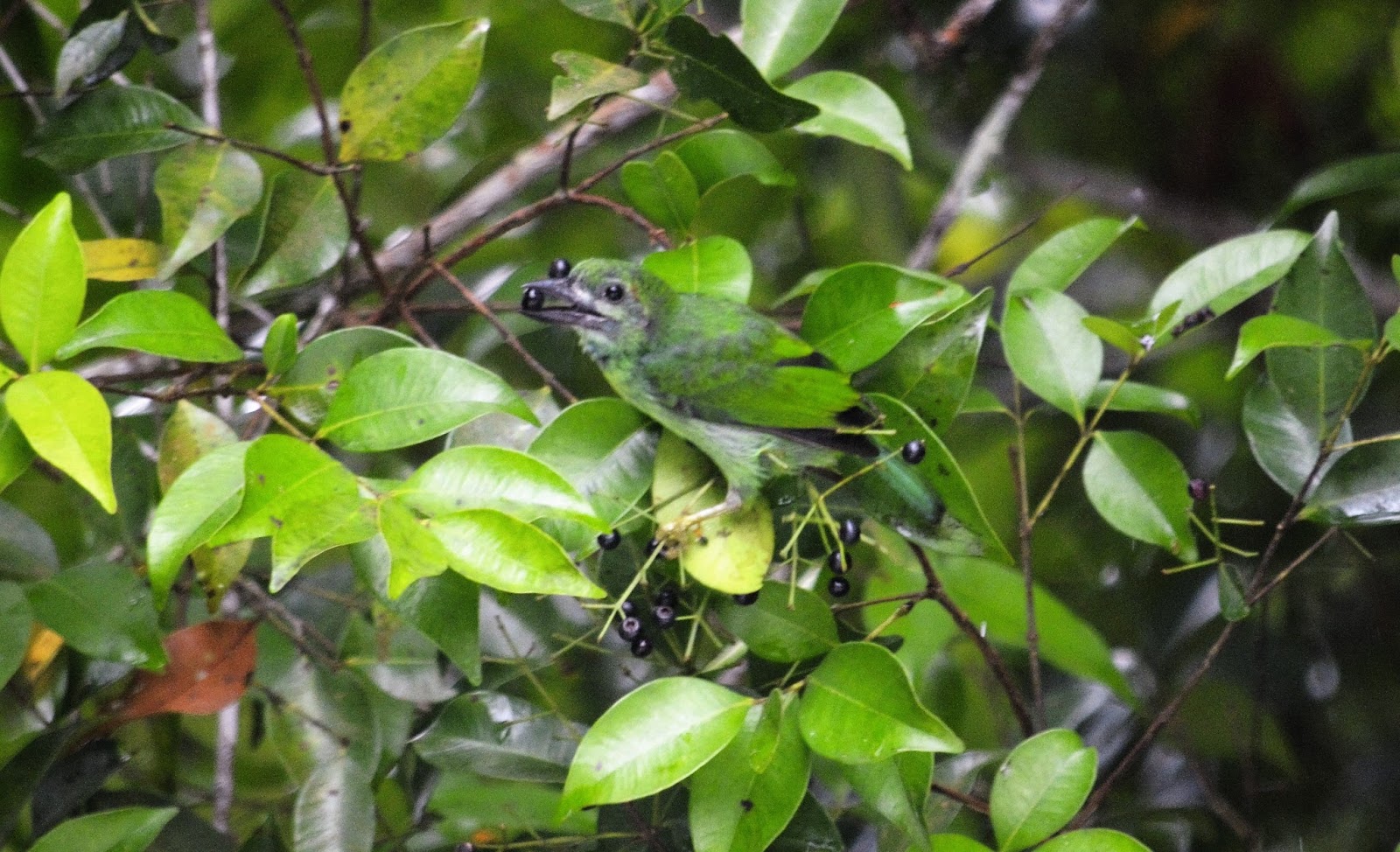
An unindentified bird


 Last June when the Eugenia oleina trees were fruiting, many birds that were never seen before at the park appeared for the first time.  The three lifers were the Red-crowned Barbet, Blue-eared Barbet and the Brown Barbet.  There was however another bird that remain unidentified and today I have  time to re-look at the pictures I took on the 22nd of June.  My best guess at the moment is that the bird is a leaf bird. But on this third largest island of the world i.e. Borneo, there are many species of leaf birds and upon checking the internet sources for images close to the ones I took, there seem to be none that is the same.  So for record purposes, I'll leave it to time to tell and probably some readers or birders can suggest a name that is true to the pictures. Or could it be that I have found a lost species? (LOL)