Showing posts with label Ferns of Sarawak. Show all posts

Monday, September 26, 2016

Fields of Miding

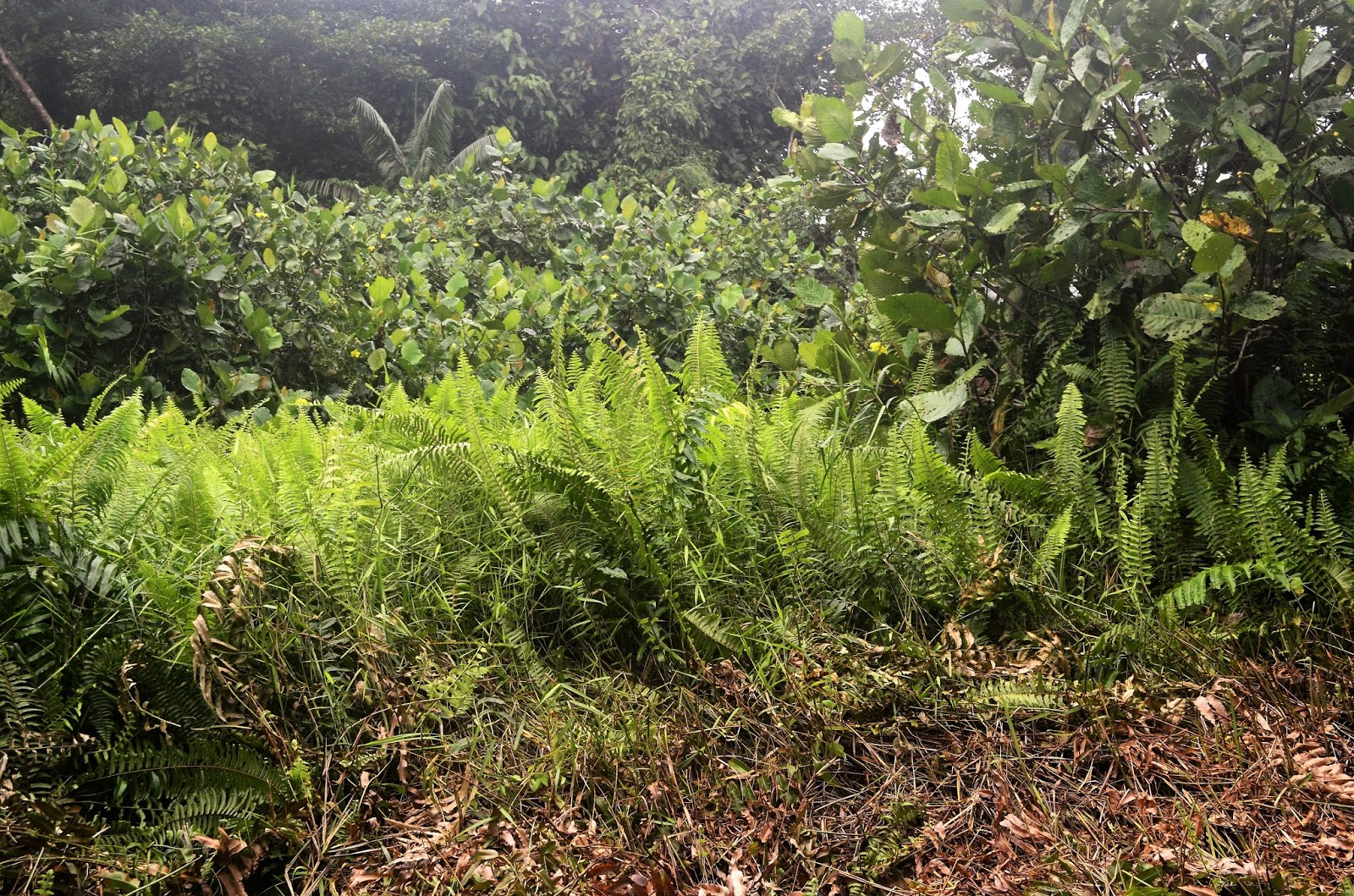
View of 'fields of Miding' at Pipit Wetlands
Location: In middle of Zones G, H and A
I have a loving weakness for Miding.  These freely obtainable and freshly plucked ferns are my favourite vegetables.  My love affair with this  no maintenance, healthy and wild growing fern seems to find no end.  The two areas at the park that have been reserved for the 'cultivation' of these ferns are quite established now.  One field of Miding is situated at the Keruak Wetlands and the other at the Pipit Wetlands.  The Miding is one of the most expensive vegetable sold at the 'tamu' or jungle produce market in Bintulu town.  The price ranges from RM 8 - RM 10 per kilo. At the park however these delicious ferns are free for the taking. Believe me some things are really free in life, 'Miding' included.  Just take a little effort to grow them naturally so as to enjoy Nature's free gift daily.

Field of  Miding at Keruak Wetlands
Location : Between Zone B and C

Tuesday, June 28, 2016

Ever free ferns from Kruak wetlands

A mixture of 'Miding' and 'Paku Uban' ferns at Kruak Wetlands

Paku Uban (foreground)
Miding (background , at left of picture)
 You can enjoy plucking  free ferns any day of the week within minutes of walking.  This phenomenon is made possible by developing an area of about half an acre within the park focused on the 'cultivation' of edible ferns.  Two species of ferns that grow naturally here are the Miding ( Stenochlaena palustris) and the Paku Uban (Nephroplepsis acutifolia).  These ferns love bright sun, damp ground mixed with tall grasses as natural support.  At the moment I am developing part of the Kruak wetlands specifically for this purpose.  I have blogged a fair bit about these ferns and how to cook them.  Please follow this link to know how...>>>>http://kambatikpark.blogspot.my/2014/04/wonder-fern-at-park.html
Young leaves of Miding

'Miding' ferns freshly collected from Kruak wetlands

Miding served with rice
Kruak wetlands
Zone B

Friday, May 27, 2016

Free, fresh and fulfilling fern

Lunch at the park.

A small basketful of Miding
 It is one of my favourite food at the park.  It is free, fresh and fulfilling.  This morning I collected the 'Miding' ferns ( Stenochlaena palustris) in ample quantities for a decent lunch (see inset).  These ferns grow wild and naturally in damp areas near the Kruak wetlands.  The quantity I collected this morning would have cost me RM 2 if I were to buy it at the local 'tamu' ( jungle produce market).  The miding ferns have first of all to be fried with the famous shrimp paste of Bintulu called 'belachen' in the local Melanau dialect ( Belacan - Malay) .   The paste is pounded with other ingredients like anchovies, red chillies etc. Once fried you need to consume the freshly cooked miding  with hot rice and perhaps a little fish meat. That's the fun of it.  Quick to get, quick to eat.  Very fulfilling. Thanks to nature.
Free, fresh and fulfilling fern.

Sunday, March 20, 2016

Vertical gardens at the park

Provinsi Lady Palm, Zone C

 There are lots of vertical gardens at the park. I mean the oil palm trees provide the best environment for many shade plants especially the ferns species, climbers and orchids to germinate on the damp, organic and fertile cut bases of the oil palm leaves that are left after successive harvesting. One advantage of keeping these vertical gardens is that you don't have to worry about watering or fertilising the plants.  The plants get their nutrition from  the rotting organic cut bases which are kept moist under shade.  The cut bases also contain dead insects as well as birds droppings which help fertilise the growing plants.  In order to take advantage of the available space, more suitable plants like orchids can be attached. Let the orchids then grow naturally with no maintenance whatsoever while enhancing the 'garden' with colour and a little fragrance.
Bird's nest fern ( Asplenium nidus)

Growing luxuriously are the Nephrolepsis  ferns 

Corsage fern (Davallia denticula) grows extremely well on the tree trunks

Pigeon orchids are a common species that adapt well to the oil palm trunks.

Thursday, October 15, 2015

Closer view of the disc

Disc Stag's Horn Fern - Platycerium coronarium
Location : Botanic Island One

Disc Stag's Horn Fern - Platycerium coronarium
Location : Botanic Island One

Saturday, March 7, 2015

Tie a staghorn on the old Lumok tree

Lumok tree (Artocarpus odoratissimus) is seen at center
Location : Zone C

Staghorn fern ( Platycerium coronarium  ) secured on the branches.
The park has a considerable number of Staghorn ferns that grew naturally in the Botanical Islands and well-preserved for posterity.   I have accumulated a number of plantlets over the years and tender them till they grow reasonably big.  Today I decided to place one on an old Lumok tree.  The above pictures show the result of the work.

Friday, July 25, 2014

The many bird's nest ferns

The making of a bird's nest fern collection... proposed site

Asplenium nidus - removed from oil palm
temporarily nursed
 I would not have done justice to the oil palm ecology if I don't have a mega  bird's nest ferns collection at the park.  It is an ongoing project now to collect as many young bird's nest ferns from the oil palm trunks and re-group them in one location.  The oil palms produce ideal conditions for these epiphytic ferns and as such sourcing is of no real problem.  They grow here from spores that are blown by the wind.  It is at the sporophyte stage that we recognize the bird's nest fern by its tightly clustered leaves forming a funnel or 'nest'.  Among the Berawans of Sarawak, the slightly older leaves are heated for about 1-2 minute and applied to the area meant to cure cancer and tumour.  But for now we are focussed on making it an ornamental landscaping potential. 
Bird's nest fern growing in ideal conditions at Botanic Island One

Bird's nest fern (Asplenium nidus)
Location : Botanic Island One

Young bird's nest ferns on oil palm, attached to the cut bases of oil palm leaves

Thursday, May 22, 2014

Hot on heels on ferny trail (Part 5)

Paku Kelindang (Iban) - Blechnum oreintale
Location : Zone I

Fiddlehead of the Paku Kelindang
 The Paku Kelindang, which is Iban for the Blechnum orientale fern can be seen throughout the park.  It can grow tall to about 2 meters high.  At the inset is the fiddlehead of the Paku Kelindang, which will grow into the fern leaves or fronds.  For the natives of Sarawak the young fronds are consumed as vegetables.  What is more interesting is the practice of the Berawans here who pound these young fronds into a paste and then apply them to the skin that is affected by boils or 'Bisul' in Malay.  It is said to help out in fast recovery of the boil because it assist in  the removal of the pus.  The size of the fern and height makes it a good candidate for landscaping especially natural landscaping style.
Paku Kelindang fiddleheads at different stages of growth.

Young frond of Paku Kelindang

Paku Kelindang
Location : Zone I

Tuesday, May 20, 2014

Hot on heels on ferny trail (Part 4)

Bird's Nest Fern - Asplenium nidus
Location : Botanic Island Two

 The Bird's Nest Fern is seen in abundance at the park.  Young ones start life early at the rotting cut bases of the oil palm fronds from which they can be easily removed and nursed elsewhere.  However to see them hugging jungle tree trunks at low level is a prized reward when walking the jungle. I have seen many examples of these ferns used extensively and effectively as landscape plants.  They could be grown in big pots, grown on urban trees, arranged on ground in formal or informal settings.  Here's some more images to show their landscaping uses.... 
Young Bird's Nest Fern growing well on decaying cut bases of oil palm fronds
Location : Zone C

Asplenium nidus arranged in formal setting

Asplenium nidus on urban tree

Asplenium nidus in natural and informal setting..
Location : Botanic Island One

Monday, May 19, 2014

Hot on heels on ferny trail (Part 3)

Tree fern (Cyathea latebrosa)
Going deeper into the forest, trying to catch a glimpse of the Tree Fern.  Found one good specimen.  The Tree fern has not grown old or big enough to show a big trunk size.  It is a beautiful sight to see the lace-like patterns of its leaves against the light.  The site was covered with a thick layer of leaves left hundreds of years ago. 

Tree fern (Cyathea latebrosa)
Location: Botanic Island Four
Licuala spinosa - solitary form
 The kind of environment the Tree Fern thrives are many in the park, well-preserved for posterity.  It is also home to the Licuala palms and terrestrial orchids.  On the more sunny areas of the park can be found the climbing ferns.  There are many species of this fern, the common one being the Lygodium flexuosum.
This species of climbing fern can be seen trailing up the oil palm trees, on ground, small trees and shrubbery and thickets of grasses.
Climbing Fern (Lygodium flexuosum)

Climbing Fern (Lygodium flexuosum) - on ground level

Climbing Fern (Lygodium flexuosum) - on oil palm tree

Climbing Fern (Lygodium flexuosum) - on Belian post

Orchids on damp forest floor
I consider myself fortunate in many ways.  To have a forest environment just a few yards where I stay is indeed a dream come true.  There is so much to discover and so much to build upon the present by introducing new ferns species for study and bio-diversity purposes.  Like today I was enthralled to see a green stick insect which I never encountered before.  The surprises I experienced daily at the park makes life worth living.

Stick insect