Showing posts with label Yellow-vented bulbul. Show all posts

Friday, January 22, 2016

Training early in acquired taste

Training early to love red juicy seeds of  'Simpoh Air' 

Baby Bulbul
You would imagine that acquired taste is among the rich and famous, eating anything bizarre with out of this world pricey tag.  Mother bulbul teaches otherwise.  It entails getting out early, very early in the morning to hunt for seeds to feed its young.  A little too late is much too late because by then other ferocious birds like the black glossy starlings would dominate the scene and chase the Mother bulbul away.  The baby bulbul need to be trained early to love the juicy red seeds of the 'Simpoh Air' or Shrubby dillenia.  There are hundreds over the neighbourhood to be picked everyday but not all fruits open up  its seeds at the right time and place.  It is a bird's life, flying around to gather them, and then with sublime touch insert the seeds into the eager mouth of baby bulbul. Little bulbul needs to be trained early to love the dillenia seeds. Other types of exotic diet will come next...ants? maggots? bees?.  If only man keep to his promise of ecological biodiversity our world would be a prosperous place lamented Mother Bulbul.
Ready to lift off with priceless seed


Sunday, January 17, 2016

A mother's care

A young Yellow-vented Bulbul is being fed by its mother with the red juicy seeds of the 'Simpoh Air' ( Dillenia suffructicosa)

Wednesday, October 7, 2015

The Yellow-vented Bulbul enjoying the fruits


Yellow-vented Bulbul at the Yellow Ixora bush
Location : Zone C
In the above picture the Yellow-vented Bulbul is attracted to the ripe fruits of the Yellow Ixora.  In the park, the Bulbul catches bees, insects and eats berries, seeds and flesh of juicy fruits. The two most seen bulbuls are the Yellow-vented and the Red-eyed types.  Occasionally the Black -headed Bulbul will come out of the forest to enjoy the sunshine and make merry sounds in the park's open areas and roadside trees.

Saturday, February 28, 2015

A company of birds on old Rambutan tree

Amidst the leaves and branches are two bee-eaters and four bulbuls
Early morning hours at the park, near  Kruak wetlands
Yellow-vented Bulbul
It was very early in the morning.  The morning dew still holding on the leaves and trees.  Above the trees the  air was filled with cheerful sounds.  Some birds were feasting on the bees at the old Rambutan tree.  The Blue-throated Bee-eaters found company with the Yellow-vented Bulbuls as they rested a while amidst their busy flying schedules.  Like super-jets they flew vertically and then ascending in sharp scooping moments to catch the bees in between their beaks.  Or sometimes they might catch them on their way up to the skies.  It was a wonderful sight to see and hopefully it will happen again another day...

Sunday, February 15, 2015

A thrilling moment of flight and attack

Over the tall  'Balem' trees were seen the bulbuls and bee-eaters in a thrilling moment of flight and attack.
Location  Zone C
Yellow-vented Bulbul with a bee
Blue-throated Bee-eater in aerobic show after the bees.
It was a thrilling moment to see some aerial acrobatics this morning.  The Yellow-vented Bulbuls were joined by the Blue-throated Bee-eaters as they furiously fly vertically to snatch some bees that were blown adrift above the tall 'Balem'  and 'Rambutan' trees.  The show lasted for about 30 minutes and the moment their prey were blown elsewhere the bulbuls continued with their hunt, but the bee-eaters decided to carry on flying south as usual. 

Friday, February 6, 2015

After the bees

A Blue-throated Bee-eater having a brief rest in a thrilling moment of hunting for the bees
Location : Cempedak Hill, Zone G

Blue-throated bee-eater
Merops virilis
 I have always waited for this moment.  The time when a swarm  of bees would occasionally be blown by a fair wind over the park.  The bees will get the best attention from the passing Blue-throated bee-eaters and the more permanent residents of the park - the Yellow-vented Bulbul.  It is always a delight to see their playful and acrobatic acts as they take-off from the perches and rising vertically to snatch the bees in between their beaks.  The Bee-eaters are always passing the park early in the morning as they fly in flocks in a southerly direction.  They would before sunset fly above the trees in a northerly route taken years now while returning with satisfied appetites. It is a routine no doubt and nature has planned well for the bee-eaters.  To see them thrive in my lifetime is an experience I treasure most.  They should be left like what they used to be - free and a timeless beauty.
Yellow-vented Bulbul with a bee in between its beak.
Location : Cempedak Hill, Zone G.

Saturday, May 10, 2014

One fine morning

Yellow-vented Bulbul (Pycnonotus goiavier)

 Today the weather is cloudy but dry.  The weather at the park early morning was cool and good to enjoy a walk in the park.  At Zone C, I saw a Yellow-vented Bulbul resting on a perch to groom itself.  This bulbul is the commonest variety in Bintulu as it can be seen in populated areas.  It is also resident at the park.  They are usually seen in pairs or small flocks.  An adult of the species  has a short crest.   I often see them attracted to the Shrubby Dillenia red seeds that are available daily in large quantities.  To see them  in the morning trying to be first in getting the red seeds is a joy to watch.  They make no pretense in making their peculiar bubbling calls when devouring the seeds or  ants.
Grooming on a perch.

Monday, May 5, 2014

The bubbling Bulbul

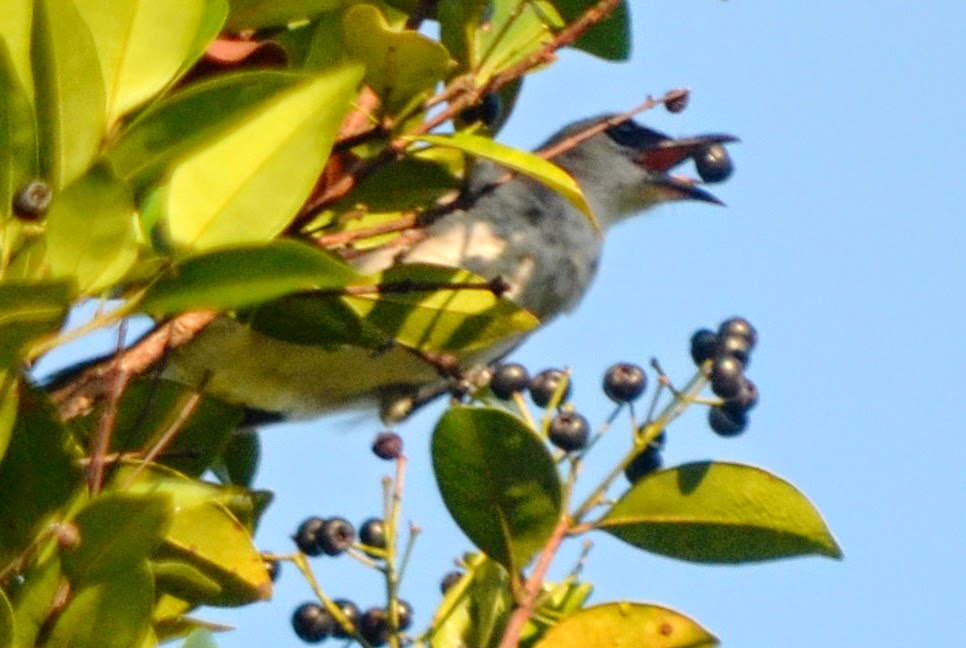
Yellow-vented Bulbul attracted by the black berries of the Eugenia oleina tree

 There are among the early birds normally attracted to the red  ants that are in large supply at the Shrubby Dillenia trees.  They compete for the red seeds of the Dillenia from other birds like the sunbirds.  Coming in small groups, they make cheerful bubbling sounds.  Within the last week, this week and probably next, they will continue to visit the park due to the presence of thousands of black berries of the Eugenia oleina trees.  The most common variety to be seen is the Yellow-vented Bulbul (Pyconotus goiavier).  On many  occasions they can also be seen chasing after swarm of bees that are drifted by the wind over the park.


Tuesday, January 28, 2014

Photoshoot session with a young Yellow-vented Bulbul

Yellow-vented Bulbul (Pycnonotus goiavier) - Merbah Kapur (Malay)
Family: Pycnonotidae (Bulbul family)


 Today the weather is cloudy and the air is rather cold with light breeze.  Between Zone F and Zone C I saw a young Yellow-vented bulbul having a rest on a short twig and looking cold.  It was initially unaware of me as I slowly approached to photoshoot it.  It seemed oblivious to the clicking sounds of the camera and despite seeing me moving towards her slowly she gave me more poses.  She gave me an excellent opportunity to be close and personal.  Here's more revealing shots of the young bulbul....


Monday, December 23, 2013

December rains

The park looking south-west from hill at Zone C

Zone F
 The Kambatik Park is right in the midst of the monsoon rains which is from the months of November to February every year.  As usual when the rains are heavy the stream waters will overflow and creating flash floods.  Here's some images of the park in the rain today.
Zone F, Provinsi Carpentaria


Zone F, Provinsi Carpentaria


The Kambatik stream overflows...

Zone D, near Heliconia Valley

Eugenia oleina fruits
 Despite the rains, the bulbuls came throughout the day to eat the Eugenia oleina fruits that are in abundance at the park at the moment. The presence of an old dead tree provided convenient perches  for them to rest amidst their flight  schedules.
Bulbuls rest at an old dead tree

Bulbuls rest at an old dead tree

Flowers in the rain (Dillenia suffructicosa)

Flowers in the rain


 In light rain  the little spiderhunter  took to  the brief opportunity to search for food.  While the bulbuls kept themselves busy at the Eugenia oleina fruits the little spiderhunter was hurrying in bewteen the ixora and cream fruit flowers for their nectar.
Little spiderhunter at the cream fruit lowers...(Strophantus gratus)


Red flowers of the Drunken Sailor (Quisqualis indica) in the rain...

Eugenia oleina branches bending over due to the combined weight of the fruits and rain..