Showing posts with label Dillenia suffructicosa. Show all posts

Saturday, March 10, 2018

A monitor lizard at Kruak wetlands

Monitor lizard basking at the edge of Kruak Wetlands
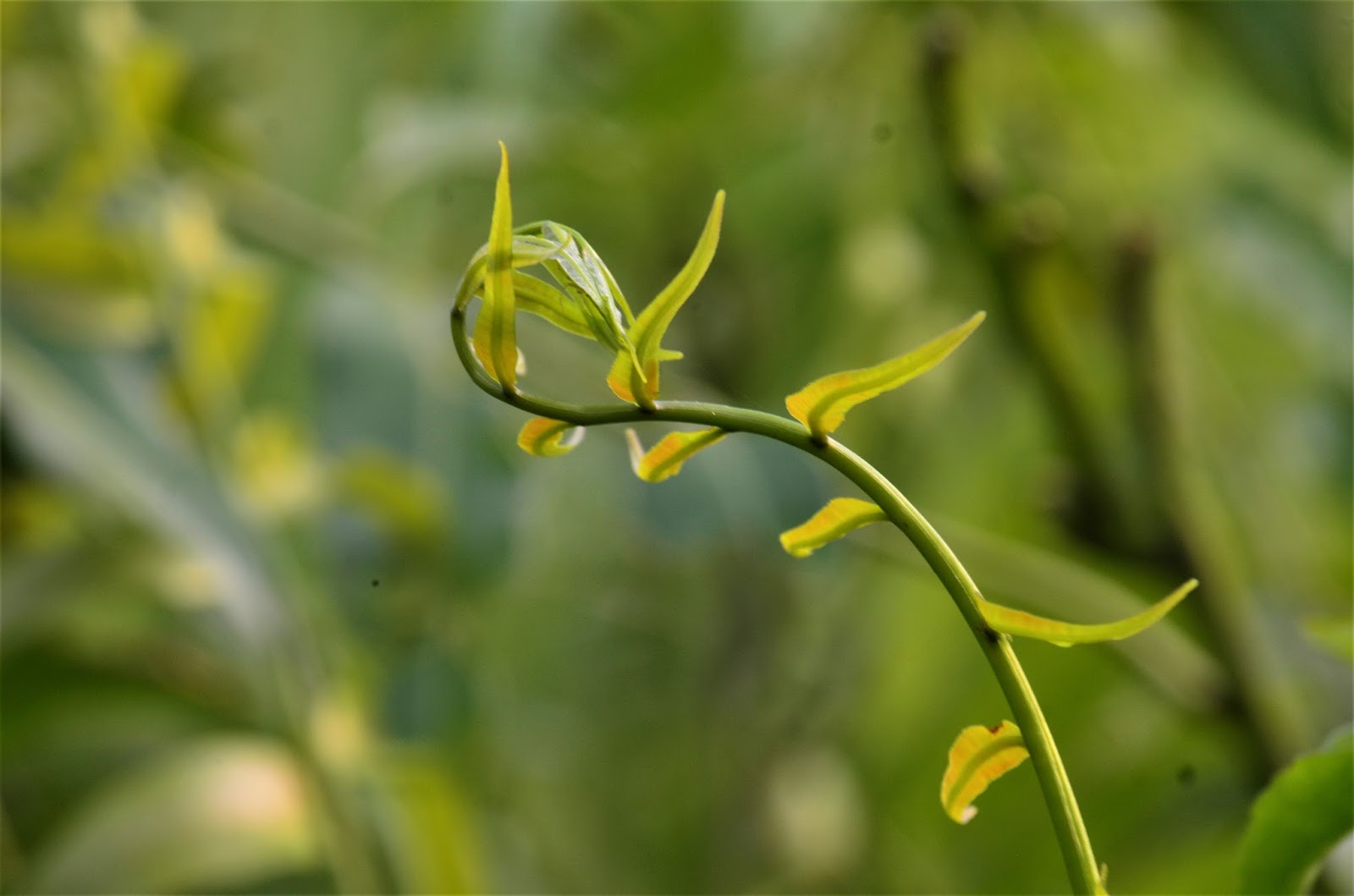
Edible young 'Miding' fern.
The Kruak wetlands has  brought a big surprise today with the sighting of a monitor lizard.  A tall dead tree nearby was a perfect place for it to bask in the sun.  The area seems to be a favourite place for the lizard primarily for its damp and wet ground, thick vegetation to hide and probably for the availability of food.  It is also my favourite place for collecting the "Miding' ferns for vegetable cooked with the popular local paste called 'Belacan' of course! On the sidelines I met a lone Shield Bug clinging to the broad leaf of the 'Simpoh Air' (Dillenia suffructicosa).  The Kruak wetlands is thickly populated with the Simpoh Air plant.
The tall dead tree is seen in the middle of the picture.  In front is seen a section of Kruak Wetlands that is thickly populated with the Simpoh Air (Dillenia suffructicosa) shrub.
Shield bug, many are seen clinging on to the broad leaf of the Simpoh Air.

Thursday, July 7, 2016

The versatile and functional 'Simpoh Air'

'Simpoh Air' thickets at Pipit Wetlands in mixed planting

'Simpoh Air' thickets at Kruak Wetlands

Long shot view of 'Simpoh Air' thickets at Pipit Wetlands

'Simpoh Air' thickets at the foreground
Location: Pipit Wetlands
The 'Simpoh Air' or Shrubby dillenia (Dillenia suffructicosa) is grown here in mass planting scheme or thickets.  It has characteristic broad leaves and prodices fruits much-liked by the Sambar deer.  Thus the shrub  is purposely planted to attract the coming of Sambar deers to the park especially during and a few days after every full moon of the month.  They provide cover for many other animals especially those grown near wetlands e.g. monitor lizards, civet cats, squirrels and nesting grounds for birds.  Many insects are attracted to its flowers and birds to its juicy red seeds.  The 'Simpoh Air' grows well on wet grounds as well as dry areas and thus is a versatile and no-maintenance plant.  Grown as thickets, they reduce much maintenance work e.g. grass cutting and thus minimise costs of care of the park yet attract a  diversity of wildlife.  Young leaves of the 'Simpoh Air' can be eaten as salad and older leaves are used as natural wrappers for food.  In other parts of Sarawak, the long straight stems of the plant are used for pepper posts.

Thursday, April 21, 2016

The mating process of the Shield Bug (Pycanum rubens)

The Approach

The Climb

The Copulation

The Consummation

Shield Bug - Pycanum rubens
Host plant - Simpoh Air (Dillenia suffructicosa)
Location : Zone I

Friday, January 22, 2016

Training early in acquired taste

Training early to love red juicy seeds of  'Simpoh Air' 

Baby Bulbul
You would imagine that acquired taste is among the rich and famous, eating anything bizarre with out of this world pricey tag.  Mother bulbul teaches otherwise.  It entails getting out early, very early in the morning to hunt for seeds to feed its young.  A little too late is much too late because by then other ferocious birds like the black glossy starlings would dominate the scene and chase the Mother bulbul away.  The baby bulbul need to be trained early to love the juicy red seeds of the 'Simpoh Air' or Shrubby dillenia.  There are hundreds over the neighbourhood to be picked everyday but not all fruits open up  its seeds at the right time and place.  It is a bird's life, flying around to gather them, and then with sublime touch insert the seeds into the eager mouth of baby bulbul. Little bulbul needs to be trained early to love the dillenia seeds. Other types of exotic diet will come next...ants? maggots? bees?.  If only man keep to his promise of ecological biodiversity our world would be a prosperous place lamented Mother Bulbul.
Ready to lift off with priceless seed


Wednesday, January 20, 2016

Waste not a seed


The female of the Brown-throated Sunbird searches for the few remaining red juicy seeds of the 'Simpoh Air' (Dillenia suffructicosa)  before  other  bigger birds enter the scene for their share.

Monday, January 18, 2016

Sunday, January 17, 2016

A mother's care

A young Yellow-vented Bulbul is being fed by its mother with the red juicy seeds of the 'Simpoh Air' ( Dillenia suffructicosa)

Tuesday, November 17, 2015

Use of the tongue

Yellow -vented Bulbul

Brown-throated Sunbird, female of the species.

Pink-necked Green Pigeon, male.
The red juicy seeds of the Simpoh Air or Shrubby dillenia are attractive to many birds.  In the above pictures , I noticed that the tonque is vital as a balancing organ to hold the seed and position it between the beak and then flip the seed into the mouth of the bird.  This is important because only when it is held steady and central that the birds can easily gulped the seed.  Failing which the seed might fall and be wasted.

Wednesday, November 11, 2015

A groovy kind of dillenia

Brown-throated Sunbird, female of the species at the Simpoh Air branch
Location : Wetlands between Zone G and Zone A
Female of the Pink-necked Pigeon
A groove of Shrubby Dillenia
Its a beautiful groove of broad leafy thicket.  A natural mass of deep green beauty amidst a jungle surrounding and open grassland where wildlife abound.  It is a groovy kind of landscape, soft green in the foreground and dark green washes at the back.  It's a place where the pigeons, sunbirds and bulbuls visit everyday for the tiny juicy seeds of the Shrubby Dillenia or 'Simpoh Air'. It is of vital importance to keep this groove for the many attractions it provides - fruits and seeds to many species of birds, flowers for insects and small animals.  The young flushes of the dillenia are edible as salad and during nights when the moon is high the Sambar Deer would occasion the pebbled-sized fruits of the dillenia as part of its regular diet.  There are many dillenia grooves at the park that are home for the buzzing wildlife.  And I never stop to learn and appreciate how a little sanctuary we build here has given us so much love for nature and a passion for simple living and happiness it brings. The falling leaves, November rain, the fresh winds and the walks in the park. Come what, come may.  It's a groovy kind of love.

Yellow-vented Bulbul against the clear blue sky of  November

A pair of Pink-necked Pigeon 

The female of the Brown-throated Sunbird having a mouthful of the red juicy seed of the Shrubby Dillenia.

The Simpoh Air in a mixed natural landscape scenery, interspersed with oil palm trees.
Zone G.

Thursday, June 5, 2014

Bubbling bulbul picks red juicy seed

Hoover in flight and pick a juicy one
The Shrubby Dillenia (Simpoh Air - Malay) grows wild at the park especially on open spaces.   They thrive and develop into thickets.  But many small seedlings are also seen scattered by the hundreds beneath the canopy of trees and under shade.  These are a result of the seeds that the bulbuls excrete.  The bulbuls and many other birds love these juicy red seeds that are available daily when the fruit opens.  These seeds are contained in compartmented trays with white and pink borders.  To reach at the seeds the bulbul will have to hoover in flight.  They are a delight to see and hear especially their bubbling calls....

Wednesday, September 11, 2013

Under the green umbrella

Oil palm trunk with a wide sampling of ferns, and seed plants taking advantage of the fertile fibrous growing medium found between the cut leaf bases and the trunk.

Fungi on rotten leaf bases
 The Oil palm trees (Elaies guineensis) or Sawit in Malay are the main identity of the Kambatik park.  They help sustain the park's operation.  When harvesting the fresh fruit bunches, the leaf bases that are cut leave a space between the cut branches and the trunk.  The leaf bases are constantly moist and they trap small insects, birds and other small animals' droppings, dead organic matter like fungi or mushrooms etc.. They provide ideal conditions for many plants to thrive on.  Chiefly among them are the epiphytic ferns, and plants that produce seeds and are eaten by birds and other animals and are later discharged in their droppings and got trapped in the fibrous and fertile growing medium between the leaf bases and the trunk.  It would not be surprising in future also to see orchids growing from these leaf bases.
Bird's nest fern (Asplenium nidus)

Climber

Ficus benjamina

Miding (Stenochlaena palustris) - at the centerr of the picture

Rabbit's foot fern ( Davallia denticulata)

Broad leaves of the Simpoh ( Dillenia suffructicosa)


Paku Uban (Iban) - Nephrolepsis acutifolia

Saturday, July 6, 2013

Flushes in the park

Pometia pinnata - Kasai (Malay)

Dillenia suffructicosa - Simpoh air (Malay)
 In a broad sense we need colour in a park to make it a beautiful and memorable place  to visit.  In the evergreen tropical forest environment, flushes are a welcome change providing an autumn-like atmosphere that can actually be seen throughout the year.  I am fortunate to have a good collection of native plant species that produce varying colours of young leaves.  Among the significant ones are the Pawas, Simpoh air, Jering and Balem trees.  To make the flushes appear many times, I have introduced many other tree species like the Ceylon Ironwood , Eugenia oleina and  Kasai . 
Messua ferrea - Ceylon Ironwood
 The Ceylon Ironwood tree produces young leaves in pink flushes and they hang limply in tassels until they become harder and leathery.
a jungle plant species, native to the park..

Eugenia oleina - Syn: Syzygium campanulatum
The Eugenia oleina trees was the first batch of trees I introduced here as roadside trees along the park roads.  They have small narrow pointed leaves and produce young leaves in appealing pink colours. The oleina trees when in flower attract hordes of butterfly species, birds and bees.  At fruiting stage the fruits are savoured by the Philippine glossy starling birds and bulbuls .
Eugenia oleina

Pawas
 The Pawas tree is native to the park.  To the best of my knowledge I noticed that after a season of arrival at the park, the Philippine Glossy starling birds would leave behind seeds of the Pawas in their droppings from which later sprang hundreds of seedlings of the Pawas tree in the forest undergrowth.  The young leaves of the Pawas can be eaten raw as salad or 'ulam' in Malay.
Pawas , belong to the Lauraceae or Laurel family.

Pithecolobium lobatum - Jering (Malay)

 The 'Jering' tree produces fruits that can be eaten in many ways, as salads or desserts.  Its young leaves are a maroon in colour and very attractive to see at a distance.

I guess I will try in future to add more tree species that have colourful flushes to make the park full of colours at any time of the year because some flushes envelope whole trees or canopies and appear very regularly throughout the year.


Pithecolobium lobatum - Jering (Malay)