Showing posts with label Miding. Show all posts

Saturday, March 10, 2018

A monitor lizard at Kruak wetlands

Monitor lizard basking at the edge of Kruak Wetlands
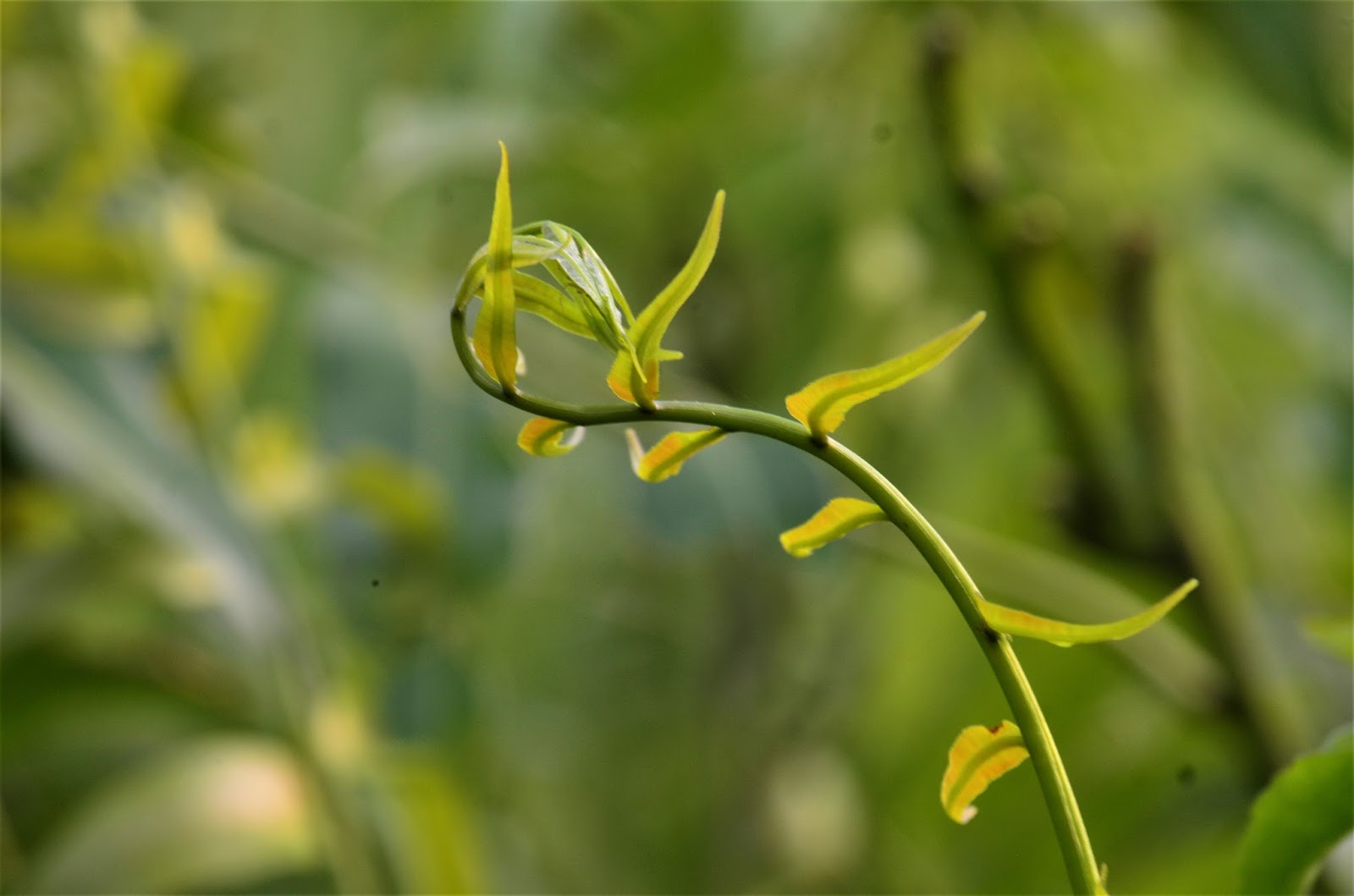
Edible young 'Miding' fern.
The Kruak wetlands has  brought a big surprise today with the sighting of a monitor lizard.  A tall dead tree nearby was a perfect place for it to bask in the sun.  The area seems to be a favourite place for the lizard primarily for its damp and wet ground, thick vegetation to hide and probably for the availability of food.  It is also my favourite place for collecting the "Miding' ferns for vegetable cooked with the popular local paste called 'Belacan' of course! On the sidelines I met a lone Shield Bug clinging to the broad leaf of the 'Simpoh Air' (Dillenia suffructicosa).  The Kruak wetlands is thickly populated with the Simpoh Air plant.
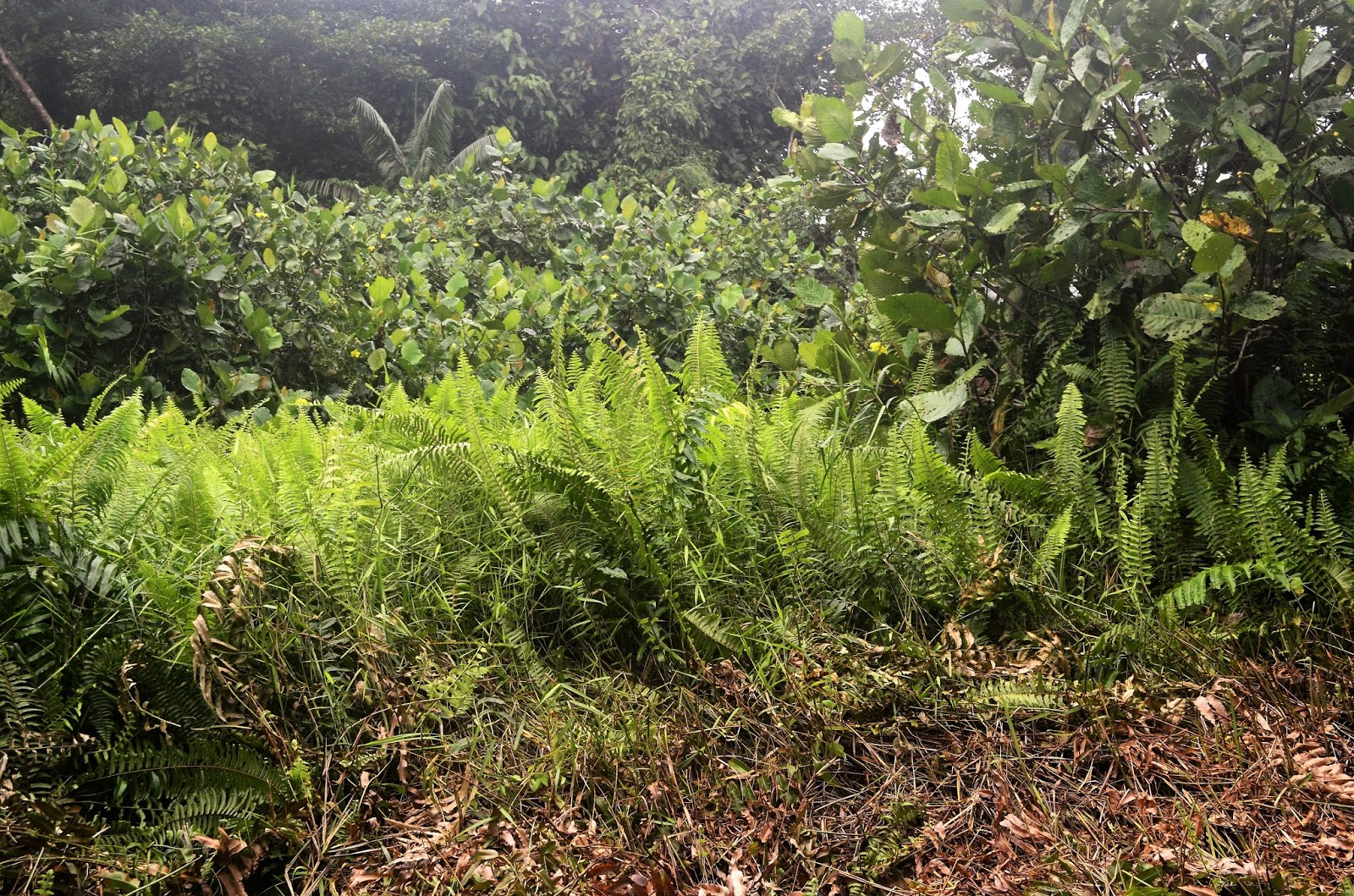
The tall dead tree is seen in the middle of the picture.  In front is seen a section of Kruak Wetlands that is thickly populated with the Simpoh Air (Dillenia suffructicosa) shrub.
Shield bug, many are seen clinging on to the broad leaf of the Simpoh Air.

Wednesday, March 7, 2018

Early days of March

View of Zone I, northwards from Zone D.
Note the Hill Myna at the lower branch, left of tree.

Zoom in view of 'Tiong' (Hill Myna) 
 The early days of March have seen a return to the 'normal' climate of Bintulu which is rain at night and most days sunny.  There is thus plenty of time to do birding.  The very tall and huge jungle tree at Zone I which has been standing proudly was the arena of loud calls from the Tiong bird (Hill Myna).  Walking around the park is a daily routine to observe as many wildlife, plant life and scenery.  The Jambu Air tree ( Syzgium aqueum) is starting to bear more and bigger  fruits. The preservation of original jungle habitat as in the form of botanic islands have ensured the survival of stick insects of various types and sizes.
Early morning view

Jambu Air (Syzgium aqueum) - Zone B

Miding at Zone A.
Stick insect at Botanic Island Two

Botanic Island One with 'Draceana kambatika' at foreground

Monday, September 26, 2016

Fields of Miding

View of 'fields of Miding' at Pipit Wetlands
Location: In middle of Zones G, H and A
I have a loving weakness for Miding.  These freely obtainable and freshly plucked ferns are my favourite vegetables.  My love affair with this  no maintenance, healthy and wild growing fern seems to find no end.  The two areas at the park that have been reserved for the 'cultivation' of these ferns are quite established now.  One field of Miding is situated at the Keruak Wetlands and the other at the Pipit Wetlands.  The Miding is one of the most expensive vegetable sold at the 'tamu' or jungle produce market in Bintulu town.  The price ranges from RM 8 - RM 10 per kilo. At the park however these delicious ferns are free for the taking. Believe me some things are really free in life, 'Miding' included.  Just take a little effort to grow them naturally so as to enjoy Nature's free gift daily.

Field of  Miding at Keruak Wetlands
Location : Between Zone B and C

Tuesday, June 28, 2016

Ever free ferns from Kruak wetlands

A mixture of 'Miding' and 'Paku Uban' ferns at Kruak Wetlands

Paku Uban (foreground)
Miding (background , at left of picture)
 You can enjoy plucking  free ferns any day of the week within minutes of walking.  This phenomenon is made possible by developing an area of about half an acre within the park focused on the 'cultivation' of edible ferns.  Two species of ferns that grow naturally here are the Miding ( Stenochlaena palustris) and the Paku Uban (Nephroplepsis acutifolia).  These ferns love bright sun, damp ground mixed with tall grasses as natural support.  At the moment I am developing part of the Kruak wetlands specifically for this purpose.  I have blogged a fair bit about these ferns and how to cook them.  Please follow this link to know how...>>>>http://kambatikpark.blogspot.my/2014/04/wonder-fern-at-park.html
Young leaves of Miding

'Miding' ferns freshly collected from Kruak wetlands

Miding served with rice
Kruak wetlands
Zone B

Monday, June 27, 2016

The Pipit Wetlands

View of Pipit Wetlands, taken from Zone A looking south east.
The landscape consists of tall grasses at the ground floor level and as the land scales up the slope and surrounding hill, the thickets of Shrubby dillenia, are intermixed with natural stands of trees. At the far back the original jungle is retained for its ecological diversity.  The intermediate storey is filled up with introduced oil palm cultivation.

Pipit Rawa (Malay) - Chestnut munia
 There are two areas of wetlands at the park called the Kruak Wetlands and the Pipit Wetlands. The former is located between Zone B and A, while the latter is sand-witched between Zone A and G. The Pipit Wetlands is named after the 'Pipit' bird (Chestnut Munia)which frequent the area and build homes at the location. Other species of wildlife seen in the area are Snipe, Little Green Pigeon, Bulbul, Squirrel, Prinia, Butterfly, Waterhen,  Frog and Snakes. The Waterhen and Snipe occupy the ground areas , the Pipit and Prinia  birds forage among the tall grasses.  The Bulbul and Pigeon birds  build homes among the thickets of mixed vegetation at the edge of the wetlands.  The wetlands ecology is important for the park because it absorb and contain excess runoff that function as an essential reserve source of water for the natural trees and shrubbery growing in the area including the grasses and ferns. The thickets of ferns are a renewable source of 'Miding' and 'Paku Uban' ferns which are edible and can be plucked on everyday basis.  The Pipit Wetlands is thus retained due to its wildlife promoting value and ecological diversity. 

'Miding' ferns need the tall grasses to help them scramble and obtain necessary sunlight for maximum growth. Note: Young 'Miding' leaves appear light red in colour and turn green as they age.
Location : Pipit wetlands

Friday, May 27, 2016

Free, fresh and fulfilling fern

Lunch at the park.

A small basketful of Miding
 It is one of my favourite food at the park.  It is free, fresh and fulfilling.  This morning I collected the 'Miding' ferns ( Stenochlaena palustris) in ample quantities for a decent lunch (see inset).  These ferns grow wild and naturally in damp areas near the Kruak wetlands.  The quantity I collected this morning would have cost me RM 2 if I were to buy it at the local 'tamu' ( jungle produce market).  The miding ferns have first of all to be fried with the famous shrimp paste of Bintulu called 'belachen' in the local Melanau dialect ( Belacan - Malay) .   The paste is pounded with other ingredients like anchovies, red chillies etc. Once fried you need to consume the freshly cooked miding  with hot rice and perhaps a little fish meat. That's the fun of it.  Quick to get, quick to eat.  Very fulfilling. Thanks to nature.
Free, fresh and fulfilling fern.

Sunday, May 18, 2014

Hot on heels on ferny trail (Part 1)


Two main fern species abundantly found around the pond are 'Miding' and 'Paku Uban'
Location : Waterlily pond, Provinsi Manila @ Zone B

Paku Uban (Iban) - Nephrolepis biserrata
 Ferns are fascinating plants because even though they are non-flowering they still can reproduce by spores which lie under their leaves.  They are delicious and I have blogged a fair bit about many vegetable ferns of Sarawak.  There are about 500 species of ferns in Malaysia and Sarawak for that matter.  Ferns can survive many kinds of climatic environments.  In the park they are species that have adapted well to open sun and open spaces  whilst others prefer moist and shady areas.  This new Fern Trail project will gather as many different species of ferns as possible.  Below are some examples....  
Miding (Stenochlaena palustris)

Lycopodium cernuum - Nodding Clubmoss
Location : Zone G


Lycopodium cernuum - Nodding Clubmoss  Location : Zone G
Dicranopteris linearis - Resam (Malay)
Location : Zone I


Dicranopteris linearis - Resam (Malay) or commonly as Bracken fern.
Location : Zone I

Wednesday, April 30, 2014

Wonder fern at the park

Miding (Malay) - Stenochlaena palustris growing on the oil palm trunk

 There are many types of ferns at the park, some have epiphytic habits.  The Miding is one wonder fern here that grows luxuriously on wet areas as well as on palm trees.  Today the Miding is a 5-star vegetable that is served at many 5-star hotels or restaurants in Sarawak.  It is about the healthiest vegetable  at the park because it grows naturally without receiving fertiliser or pesticide.  Here's how to eat this fern vegetable. 

Collect as many young Miding stalks as you can (above).  They may vary in size and age, but that does not matter.  Separate the hard section of the leaf stalks to be thrown away as shown below.
How to cook the Miding:  Firstly, prepare a 'sambal' paste by pounding shallots, garlic, anchovies and 'belacan' or shrimp paste and chilies.  Secondly, stir fry the paste for about 2 minutes with a little bit of cooking oil.  Thirdly, put in the Miding vegetable and sprinkle salt to taste.  Cook for only two minutes because this type of vegetable gets cooked very fast.  Finally, served hot with rice. 
The fern Miding vegetanble cooked in sambal belacan paste, or what the Malays called "Miding tumis belacan".

Wednesday, September 11, 2013

Under the green umbrella

Oil palm trunk with a wide sampling of ferns, and seed plants taking advantage of the fertile fibrous growing medium found between the cut leaf bases and the trunk.

Fungi on rotten leaf bases
 The Oil palm trees (Elaies guineensis) or Sawit in Malay are the main identity of the Kambatik park.  They help sustain the park's operation.  When harvesting the fresh fruit bunches, the leaf bases that are cut leave a space between the cut branches and the trunk.  The leaf bases are constantly moist and they trap small insects, birds and other small animals' droppings, dead organic matter like fungi or mushrooms etc.. They provide ideal conditions for many plants to thrive on.  Chiefly among them are the epiphytic ferns, and plants that produce seeds and are eaten by birds and other animals and are later discharged in their droppings and got trapped in the fibrous and fertile growing medium between the leaf bases and the trunk.  It would not be surprising in future also to see orchids growing from these leaf bases.
Bird's nest fern (Asplenium nidus)

Climber

Ficus benjamina

Miding (Stenochlaena palustris) - at the centerr of the picture

Rabbit's foot fern ( Davallia denticulata)

Broad leaves of the Simpoh ( Dillenia suffructicosa)


Paku Uban (Iban) - Nephrolepsis acutifolia