Showing posts with label Landscape design philospohy. Show all posts

Wednesday, May 4, 2016

Loving the emergents

Botanic Island One

Botanic Island One
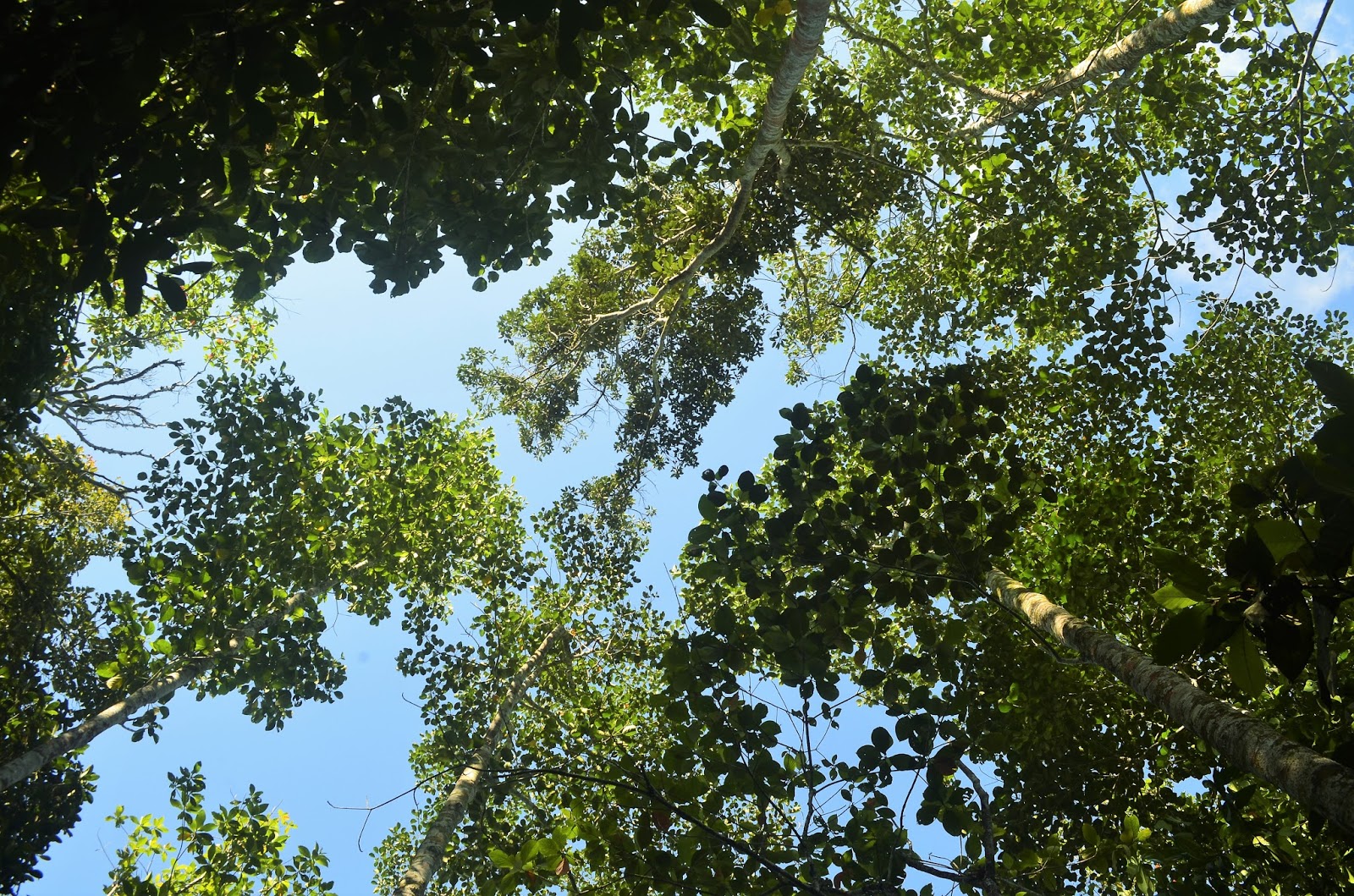
 I love the emergents.  For in the rainforest ecology of the park,  these super tall  trees rise above the landscape with a respectful 20 - 40 meters  high from the humid and leaves-littered forest floor below.  These are the forest wonders that delight me in my daily walks, their majesty proclaiming their age, rising above the competition and giving the iconic canopy and structure of the lowland dipterocarp forest.  These trees are retained as part of the agro-forestry practice of the nature park.  They are the answers that I worked hard on for many years now i.e. to re-live the green landscape of the village where I was born.  I am blessed daily to watch them grow,  close enough to walk below them, touch them and feel the ameliorating air below them. Trees are basic to any landscape, the taller the more original is the landscape.  This is so because we are living in the tropical rainforest zone on Borneo Island which contains one of the oldest and richest ecological diversity gems on this planet.  Life is really worth living with them as neighbours,
Zone D

Zone C

Friday, July 11, 2014

Rendang is the perfect arch


Fruiting head have male and female flowers, but its the female flowers that bear the fruits.
The male inflorescence is a cluster of furry, simple spikes which resembles a hand.
 The oil palm tree is a tough plant that can live for more than 100 years.  The species Elaeis guineensis is the one planted here. This species is also called African Oil Palm.  Besides having a long life it is also the most productive oil crop in the world.  Here it is expected to give an economic life of about 20 -25 years.  The Malays have a good word to describe the health of the oil palm tree.  The conditions of the leaf especially the bottom most ones  must look graceful, curved in a semi-circular arch by the weight of the combined leaflets which is best described by the Malay word - " Rendang".  It is partly due to this Rendang arch that the oil palm tree can be made into an ornamental plant provided it is well-maintained, of robust growth, with a crown of shiny, green fronds or leaves.  The Rendang look also symbolizes gateway or protection  and for thousands of small holders in Bintulu the oil palm is thus a passport to prosperity.  Depending on the size and age of the holdings, this  'green gold' can be harvested on daily or weekly basis.  The demand will keep on increasing with unstoppable growth of world population because the minimum a breadwinner needs to keep his or her family happy and alive is cooked vegetables or fish on the dinner table.  The cheapest commercially available cooking oil in the world now is the palm oil.
Lines of graceful curves

Oil palms thrive exceeding well in the Bintulu for its tropical climate.  Epiphytes such as erns and orchids grow on them.

Thursday, December 19, 2013

Leave the grasses alone

Zone B, view looking west

 Swathes of grass cover are important in many respects.  At the park, its is an integral part of the design philosophy.  Firstly, the low mass of thick green cover are an important hideout and safe passage for the Samba deers that visit the park during the night.  The grasses produce seeds that are an important source of food to birds e.g. the pipits.  The dried grass blades and stems are used by birds to build their nests.  The swampy areas where grasses thrive and remain uncut are nesting grounds for such lovely birds like the White-breasted water hen.  In terms of cultural practice management, the presence of grass reserves tremendously save time and resources in keeping them untouched rather than the costly practice of grasscutting them weekly or monthly or even killing them with weedicide.  The grass blades and stems provide perches for small insects like dragonflies and butterflies.  Finally in landscaping aesthetics, the bold wash of light greenery provides soft buffer or  transition to the ground floor.  This helps soften the eye view and enhance compositional perspectives as the eye moves from a richly textured column of leaves above to the even and finely cut lawn at the ground level, thus making the watching experience pleasurable.

Zone B, view looking south

Zone F, view looking south

Swathes of grass cover at the ground storey, oil palm trees at middle storey and exotic fruit trees at top storey in the landscape composition.

Friday, September 20, 2013

Landscape of Kambatik - an appreciation (Part 1)


 How would you define your little space on  this blue planet?  Life gives us time and space.  In today's internet world where consumptive behaviour is the norm, the challenges to remain what is human is upscaled to a global audience.  What you 'Like' traces your consumptive behaviour.  But in abstracting your view of life there is that expressive need to balance the concept of time and space.  How do you go about it?  There are two basic ways.  First, you can build your materialistic pyramid or you can create your natural world.  I have chosen the latter path because it gives me a second chance to look forward to life.  As we progress in our life we come to the stark realisation that there are many stakeholders out there pushing the envelope of life in very unsustainable ways.  Thus I have created the Kambatik Park to express the human need to live by nature.  The Park is my attempt to bring back wildlife in landscape design and to create a sustainable and biologically diverse eco-system I can gladly call home.  In the park, the human spirit roams......
Slopes and flat areas preserved

Flat area or plain ...for recreation and promotion of wildlife...

Flat low lying and swampy areas are preserved for grassland to attract birds, insects and small animals.
These areas perform as water cacthment in heavy monsoon seasons.

Many newly introduced plants and trees function as modular fits that add to the richness of the jungle or forest puzzle, in welcoming ways.

Oil palm farming that sustains the operation of the park is well integrated into the existing or past natural ecosystem, and biologically diversity is achieved by additional planting of exotic species like herbal plants, indigenous fruit trees and flowering shrubs.  Botanic islands are conserved to perform as 'green lungs' and educational purposes.

Red flushes of a jungle tree add colour to the evergreen landscape.

With the preservation of natural forest, tiny forest birds like the Tailor bird (pic above) brave themselves and  venture into the open garden areas.
With proper planting of introduced species like the Eugenia oleina, the Park resembles moments of spring and autumn when the young leaves or flushes gives out their best colours from orange  to red.